

Ho aggiornato l’articolo con la doppia versione anche in italiano. Enjoy.
1. La domanda che nessuno in questo settore vuole fare
Tutti hanno raccontato la fusione Omnicom–IPG con il solito teatro:
“storica”, “epocale”, “game-changing”.
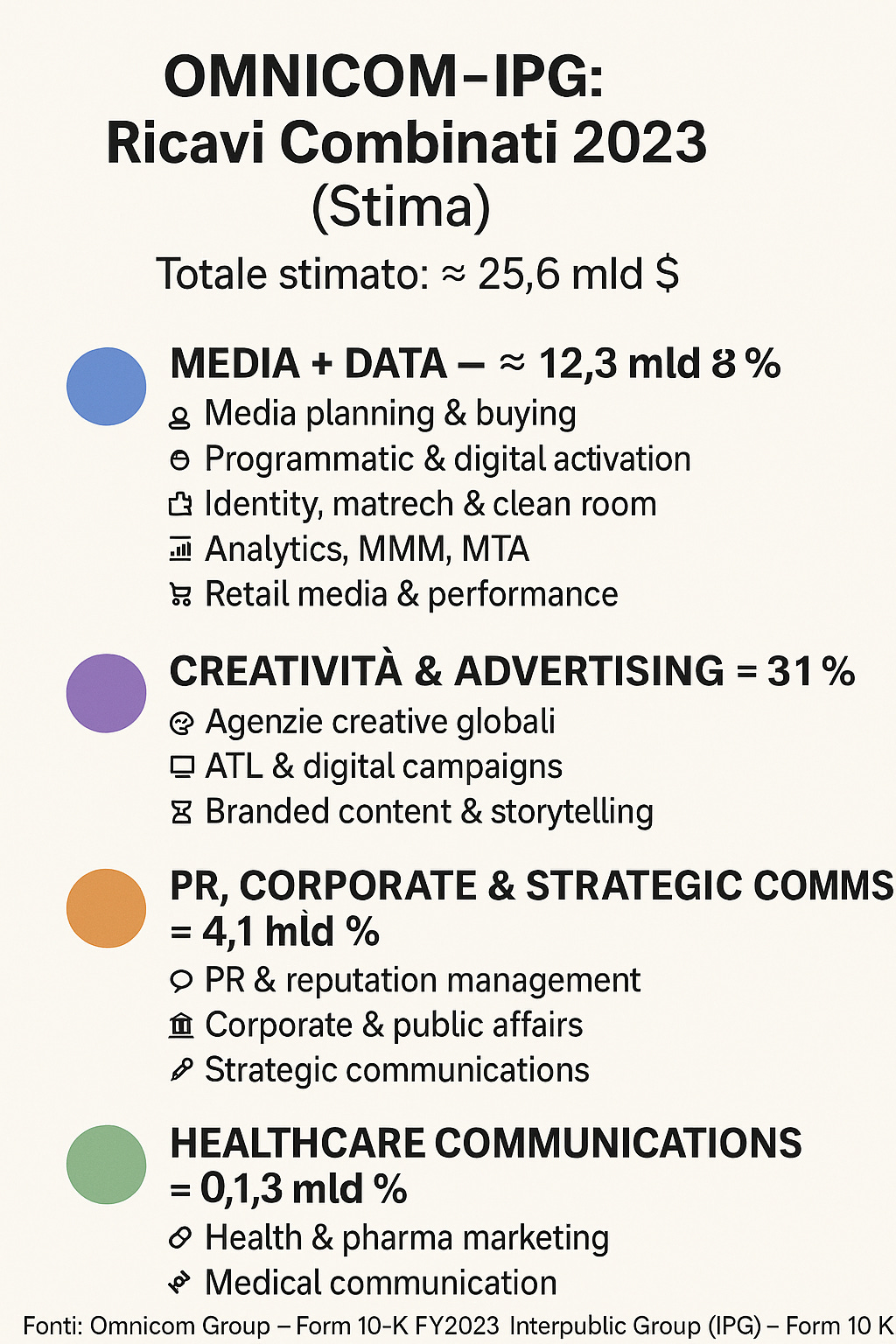
Nel frattempo, una domanda semplice e brutalmente onesta continuava a grattarmi in testa:
Qual è il ruolo reale di un intermediario media da 26 miliardi di dollari
in un mercato in cui l’attenzione è allocata dagli algoritmi?
Niente retorica. Solo matematica:
Nel 2022, Google, Meta e Amazon hanno catturato il 74% della spesa pubblicitaria digitale globale (Ebiquity).
Tre aziende.
Tutte basate su piattaforme d’asta, semi self-serve.
Se la pubblicità fosse uno Stato, queste tre sarebbero la banca centrale.
E noi continuiamo a parlare di “intermediazione”, “negoziazione”, “planning”.
Ragazzi…
la negoziazione oggi è tra macchine.
E gran parte del planning anche.
Quindi cosa stiamo facendo?
Meglio: cosa dovremmo fare?
2. La commodity che nessuno voleva ammettere fosse una commodity
Il media buying non è morto.
È diventato… deodorante.
Tutti lo usano, nessuno ci pensa, zero differenziazione.
Un lavoro che un tempo richiedeva competenze, notti in bianco, team, PowerPoint, pressione…
oggi è:
automatizzato (strategie di bidding),
standardizzato (formati),
self-serve (uno stagista può attivare una campagna Meta in 12 minuti),
livellato (tutti hanno più o meno la stessa suite, tranne il top 3% degli spender),
e sì, sempre più gestito dall’AI.
Se il tuo valore è sapere dove cliccare, sei già fuori.
Le piattaforme lo fanno meglio.
E ti suggeriscono pure i pulsanti.
La tragedia — o l’opportunità — è che il vero valore non è sparito.
Si è spostato.
A monte. A valle. Negli spazi vuoti tra i team.
È lì che le piattaforme non arrivano.
Non ancora.
3. Il cambiamento di mercato di cui non ci piace parlare
La pubblicità non è più un’industria.
È una feature di aziende che non si definiscono “pubblicitarie”.
Le piattaforme vendono impression.
Ma i brand non hanno bisogno di impression.
Hanno bisogno di chiarezza.
Chiarezza su:
narrativa,
comportamento delle audience,
attribuzione,
identità,
strategia,
contenuti che abbiano senso,
driver di business, non vanity metric.
Le grandi piattaforme ti danno dashboard,
ma non ti danno significato.
Il significato è l’ultima frontiera.
L’unica cosa che non è ancora stata automatizzata.
L’unico spazio in cui un intermediario può ancora contare.
Se lo sceglie.
4. Perché un colosso da 26 miliardi ha ancora senso (sorprendentemente)
L’istinto è dire:
“Un altro gigante? Timing sbagliato. Gioco sbagliato.”
Ma il paradosso è questo:
comprare è diventato facile.
pensare è diventato difficile.
E oggi il pensiero richiede:
dati con contesto,
creatività con struttura,
strategia con identità,
media con narrativa,
misurazione con intelligenza,
persone capaci di tradurre un linguaggio nell’altro.
È per questo che un gigante esiste:
non per comprare media, ma per orchestrare la complessità.
Se Omnicom–IPG diventa un enorme foglio Excel con le gambe → inutile.
Se diventa un layer di pensiero sopra le piattaforme → essenziale.
Lo scopriremo presto.
5. Il costo umano (la parte che la stampa non toccherà)
Ogni fusione ha un capitolo nascosto:
le persone che spariscono dalle slide.
Non siamo ingenui:
ruoli ridondanti,
dipartimenti sovrapposti,
task manuali sostituiti dall’automazione,
livelli intermedi che non giustificano più il payroll.
Ma non è tutta la storia.
Il costo più profondo è emotivo:
persone che non sanno più dove collocarsi,
professionisti bravissimi in un lavoro che non esiste più,
team che hanno passato la carriera a “ottimizzare campagne” e ora si sentono dire che la macchina lo fa meglio,
la paura silenziosa di diventare irrilevanti.
Questo articolo è per loro — per noi — per chi sente le placche tettoniche muoversi sotto i piedi.
Ci sono passato. Ho visto tutto il film.
6. Il futuro del lavoro media (e quello che nessuno dice)
Il media si sta dividendo in due specie.
A) Ruoli strategici ibridi (quelli che cresceranno)
Persone che collegano mondi:
strategia + dati + narrativa
media + creativo
brand + commerce
performance + contenuto
analytics + giudizio umano
AI + conversazione
Sono gli ecosystem thinker.
Rari.
E costosi.
B) Ruoli esecutivi (quelli che spariranno in silenzio)
report,
trafficking,
ottimizzazione manuale,
checklist,
attivazione campagne,
planning a basso livello.
Questi ruoli sono i primi a saltare in ogni fusione.
Non perché non siano utili.
Ma perché sono sostituibili — da tool, offshore, automazione.
La fusione Omnicom–IPG non crea questo cambiamento.
Lo accelera.
7. La survival list (tecnica + umana)
7 cose che avrei voluto sapere.
Una guida pragmatica, emotivamente onesta, leggermente brutale per i prossimi 36 mesi.
1. Impara a leggere i pattern, non fidarti dei processi
Ti insegnano a fidarti dei processi, ma una fusione non segue logiche lineari. O se le ha, non rispettano esperienze, risultati o contributi reali. Trova qualcuno nel board di cui ti fidi, trasforma i dubbi in informazioni e leggi il pattern. Di solito chi prende il controllo vince. Se capisci come vengono prese le decisioni, sai cosa fare.
2. Accetta che la tua identità non è la job description
Puoi evolvere senza perderti. L’industria non lo insegna.
La vita sì. Servono circa due anni perché una nuova realtà post-fusione si stabilizzi. Nel frattempo costruisci qualcosa di tuo. Qual è il tuo “superpotere”?
3. Sistema il tuo network
Hai un vero network o solo persone che conosci?
La valuta è la condivisione di esperienze e impatto reale. Chi è la persona che puoi chiamare se domani ti mandano a casa?
4. Inizia a esserci con significato
Andare a 200 eventi in modalità panico non serve. Scegli dove esserci davvero: proponi un panel, un contributo, anche gratis o pagando, ma che abbia senso.
5. Scegli la curiosità invece della nostalgia
L’industria che amavi non tornerà.
Ma se resti curioso, qualcosa di più interessante si sta costruendo. Non buttare 2 milioni in corsi su AI, coding o ingegneria NASA. Non devi andare sulla luna per restare rilevante. Potenzia ciò che sai già fare per generare impatto reale, non per impressionare il capo.
6. Sistema la tua identità digitale
LinkedIn non è il tuo CV. E il tuo job title corporate in inglese “sporco” non significa nulla fuori. Trova una voce. Capisci cosa sai davvero e dichiaralo bene nel profilo. Usa le tue competenze per spiegare in modo semplice ciò che conosci. Sei libero di mostrare il tuo impatto.
7. Investi nella tua “intelligenza narrativa”
Se sai spiegare, semplificare e persuadere, sei intoccabile.
Molti sanno eseguire.
Pochi sanno narrare.
8. Chiusura — Il nuovo significato dell’intermediazione
La vecchia definizione era:
“compriamo media per te”.
La nuova è:
“ti aiutiamo a capire il rumore”.
Le piattaforme mettono all’asta l’attenzione.
Gli algoritmi ottimizzano la delivery.
Le macchine allocano i budget.
Ma il significato —
il perché, il dove, il cosa, il chi —
appartiene ancora alle persone.
Omnicom–IPG sopravviverà se diventerà un costruttore di significato.
Altrimenti sarà solo una nave più grande in un oceano che non premia più la dimensione.
Perché nel mondo che stiamo entrando,
la chiarezza è l’unico vero potere rimasto.
E quello — meravigliosamente — è ancora umano.
1. The Question Nobody in This Industry Wants to Ask
Everyone framed the Omnicom–IPG merger with the usual theatre:
“historic”, “epochal”, “game-changing”.
Meanwhile, a basic, brutally honest question kept scratching the back of my mind:
What is the actual role of a 26-billion-dollar media intermediary
in a market where attention is allocated by algorithms?
No rhetoric. Just the math:
In 2022, Google, Meta and Amazon captured 74% of global digital ad spend (Ebiquity).
Three companies.
All running auction-driven, semi-self-serve platforms.
If advertising were a country, these three would be the central bank.
And we still talk about “intermediation”, “negotiation”, “planning”.
Guys… the negotiation is now between machines.
Most of the planning too.
So what are we doing?
Better: what should we be doing?
2. The Commodity Nobody Wanted to Admit Was a Commodity
Media buying didn’t die.
It just became… deodorant.
Everyone uses it, no one thinks about it, zero differentiation.
The work that once required expertise, late nights, teams, powerpoints, tempo…
is now:
automated (bid strategies),
templated (formats),
self-serve (any intern can run a Meta campaign in 12 minutes),
cross-leveled (everyone gets the same suite except the top 3% of spenders),
and — yes — increasingly done by AI.
If your value is knowing where to click, you’re already gone.
The platforms do that now.
They even suggest the buttons.
The tragedy — or opportunity — is that the real value didn’t disappear.
It just migrated.
Upstream. Downstream. Into the cracks between teams.
That’s the part the platforms cannot do.
Yet.
3. The Market Shift We Don’t Like to Talk About
Advertising isn’t an industry anymore.
It’s a feature of companies that don’t consider themselves “in advertising”.
The platforms sell impressions.
But brands don’t need impressions.
They need clarity.
Clarity about:
narrative,
audience behavior,
attribution,
identity,
strategy,
content that actually makes sense,
business drivers, not vanity metrics.
The big platforms give you dashboards, bu they don’t give you meaning.
Meaning is the last frontier.
The one thing that hasn’t been automated (yet).
The one place where an intermediary can still matter.
If it chooses to.
4. Why a 26-billion-dollar holding still makes sense (surprisingly)
The instinct is to say:
“Another giant? Wrong timing. Wrong game.”
But here’s the paradox:
The buying got easier.
The thinking got harder.
And the thinking now needs:
data with context,
creativity with structure
strategy with identity
media with narrative
measurement with intelligence
and people who can translate one language into another.
That’s why a giant exists:
not to buy media, but to orchestrate complexity.
If Omnicom–IPG becomes a giant spreadsheet with legs → useless.
If it becomes a giant thinking layer above the platforms → essential.
We’ll find out which one soon enough.
5. The Human Cost (the part the press won’t touch)
Every merger has a hidden chapter:
the people who disappear from the slide decks.
Let’s not be naïve:
redundant roles
overlapping departments
manual tasks replaced by automation
middle layers that no longer justify their payroll.
But that’s not the whole story.
The deeper cost is emotional:
people who don’t know where they fit anymore
professionals who were excellent at a job that no longer exists
teams who spent their career “optimizing campaigns” and are now told the machine does it better
the quiet fear of becoming irrelevant.
This article is for them — for us — for anyone who feels the tectonic plates shifting under their feet. I’ve been there. I’ve seen the whole story.
6. The Future of Media Work (and what no one tells you)
Media is splitting in two species:
A) Hybrid strategic roles (the ones who will grow)
People who connect worlds:
strategy + data + narrative
media + creative
brand + commerce
performance + content
analytics + human judgment
AI + conversation
These are the “ecosystem thinkers”.
They’re rare.
And they will be expensive.
B) Executional roles (the ones that will quietly disappear)
reports
trafficking
manual optimization
checklists
campaign activation
low-level planning
These roles go first in any merger.
Not because they’re not valuable.
But because they’re replaceable — by tools, by offshore teams, by automation.
The Omnicom–IPG merger doesn’t create this shift.
It accelerates it.
7. The Survival list (Technical + Human)
7 things I wish I knew: A pragmatic, emotionally honest, slightly brutal guide for the next 36 months.
1. Learn how to read the pattern, don’t trust the process.
They taught you to trust the process, but a merging or acquisition have no logic, or if it has it does not respect any past experience or results or effective contribution you can bring. Find someone in the boardroom you trust transform doubts into reasonable piece of information and read the pattern. Usually who takes over wins. If you understand how decisions are made, you know what to do.
2. Accept that your identity is not your job description.
You can evolve roles without losing yourself. The industry doesn’t teach this.
Life will. It takes 2 years to unfold the new permanent reality after a big merging. In the meantime build your own thing, what is your “superpower”?
3. Fix your network.
Do you have a REAL network or only people you do know? Share experience and work impact is the currency. Who is the person you can phone for help if they kick you out?
4. Start showing up with meaning
Going to 200 events under a panic attack won’t help. Select the right place to show up with meaning: ask for a panel, a contribution even for free or if you have to pay to go, but make it meaningful.
5. Choose curiosity over nostalgia.
The industry you loved isn’t coming back.
But something more interesting is being built — if you stay curious enough to see it. Don’t spend 2.000.000 euros on courses on AI or coding or NASA engineering. You don’t have to go to the moon to be relevant, think how to boost your existing skill to make a real impact not to impress your boss.
6. Fix your digital identity
Linkedin is not your CV. And your corporate shit english job means nothing out there. Start finding a voice, understand what you know well and state it good in your profile. Use your skill to share simply what you know. You are free to show how impactful you are.
7. Invest in your “narrative intelligence”.
If you can explain, simplify and persuade, you’re untouchable.
Most people can execute.
Few can narrate.
8. Closing — The New Meaning of Intermediation
The old definition was:
“we buy media for you.”
The new definition is:
“we help you understand the noise.”
Platforms auction attention.
Algorithms optimize delivery.
Machines allocate budgets.
But meaning —
the why, the where, the what, the who —
that still belongs to people.
Omnicom–IPG will survive if it becomes a meaning-maker.
If not, it’s just a bigger vessel in an ocean that no longer rewards size.
Because in the world we’re entering,
clarity is the only real power left.
And that is still — beautifully — human.