Five ideas from my Amsterdam speech on the future of television advertising, IPs and the value of audience relationships. This speech was made for egta members: sales houses, European broadcasters and adv operators.
At the EGTA/ICTA conference in Amsterdam, I challenged an audience of European television sales executives with a deceptively simple question:
What are broadcasters really selling?
Television is becoming increasingly digital: more measurable, addressable, automated and accountable.
But in the race to become comparable to digital platforms, are broadcasters overlooking the very thing that makes television different?
Because broadcasters don’t just deliver impressions. They create content, intellectual properties, cultural moments and relationships with audiences.
And perhaps the future of television advertising depends on learning how to capture more of that value.
Here are five short excerpts from my presentation.
1. Digital didn’t remove complexity. It absorbed it.
Digital advertising has fundamentally changed advertisers’ expectations.
Its competitive advantage isn’t just targeting, measurement or optimization. It’s the sense of control it gives advertisers over the entire process.
Television is investing heavily to offer similar capabilities. And rightly so.
But becoming comparable doesn’t mean becoming equivalent.
If television competes with digital exclusively on its terms, it risks reducing its distinctive value to another impression in the same buying interface.
And that raises a fundamental question: what are broadcasters actually selling beyond exposure?
2. The feudal media system and the journey of IPs
We no longer live in a single, shared media culture.
As Alan Wolk describes it, we inhabit a fragmented, almost feudal media landscape, made of communities, creators and platforms, each with its own cultural references.
Yet powerful IPs can travel across these territories.
Think of Sanremo: a television-born cultural phenomenon that lives on YouTube, TikTok, through creators and across countless communities.
Its content changes shape. Its audience encounters it in different moments and contexts.
The IP travels. But does its commercial value travel with it?
[VIDEO 2 — The feudal media system and the journey of IPs]
3. The IP stays. The relationship changes.
An IP doesn’t create the same experience everywhere it appears.
Watching a show on television, following its highlights on YouTube or discussing it inside a fan community are very different ways of engaging with the same content.
Yet advertising largely continues to price these experiences through exposure, with different CPMs reflecting different environments.
But different environments don’t necessarily explain the value of different relationships.
An IP can build familiarity, participation, emotional attachment and fandom across multiple touchpoints.
The opportunity is to understand whether those relationships can become part of what media companies sell, rather than remaining an indirect benefit of advertising exposure.
4. Advertising still has an imperial approach.
Content adapts. Advertising often doesn’t.
An IP travels across platforms, taking different forms and creating different relationships with its audiences.
Advertising, meanwhile, tends to follow an imperial logic: one message, distributed as widely as possible.
But here’s the problem.
Content earns the relationship. Advertising doesn’t automatically inherit it.
Being exposed alongside a successful IP doesn’t automatically make a brand part of that IP’s cultural relevance.
Perhaps it’s time to move beyond simply placing ads around content and start designing brand experiences that adapt to the different moments of the relationship.
AI could play an important role here, not just by making creative production cheaper, but by making it more adaptive.
[VIDEO 4 — Advertising’s imperial approach]
5. Beyond impressions: selling content and attention
Broadcasters invest heavily in talent, programming and original IPs.
Those investments generate far more than advertising inventory. They create cultural relevance, attention, fandom and relationships.
Yet the advertising business still largely monetizes the exposure generated by those assets.
What happens when an IP travels beyond the broadcaster’s own channels? Who captures the value of the relationships it creates?
Could broadcasters develop commercial partnerships that follow their IPs across platforms? Could brand entertainment become scalable rather than reinvented from scratch every time?
These are not just editorial questions.
They are product development and monetization questions.
And they could become increasingly important as broadcasters look for growth beyond traditional inventory sales.
Don’t confuse comparability with equivalence.
Television needs better measurement, automation and accountability. There’s no question about that.
But these improvements should make its distinctive value easier to buy, not make that value disappear.
Because content doesn’t just generate exposure.
It earns attention, creates relationships and sometimes becomes part of culture itself.
The next challenge for broadcasters may not simply be selling more impressions, but developing advertising products that capture more of the value their IPs already create.
I closed my Amsterdam presentation with one thought:
CPM can price exposure. But it cannot price the relationship.
And that’s where I believe the next commercial opportunity begins.
SEE YOU AT INTERSECTIONS
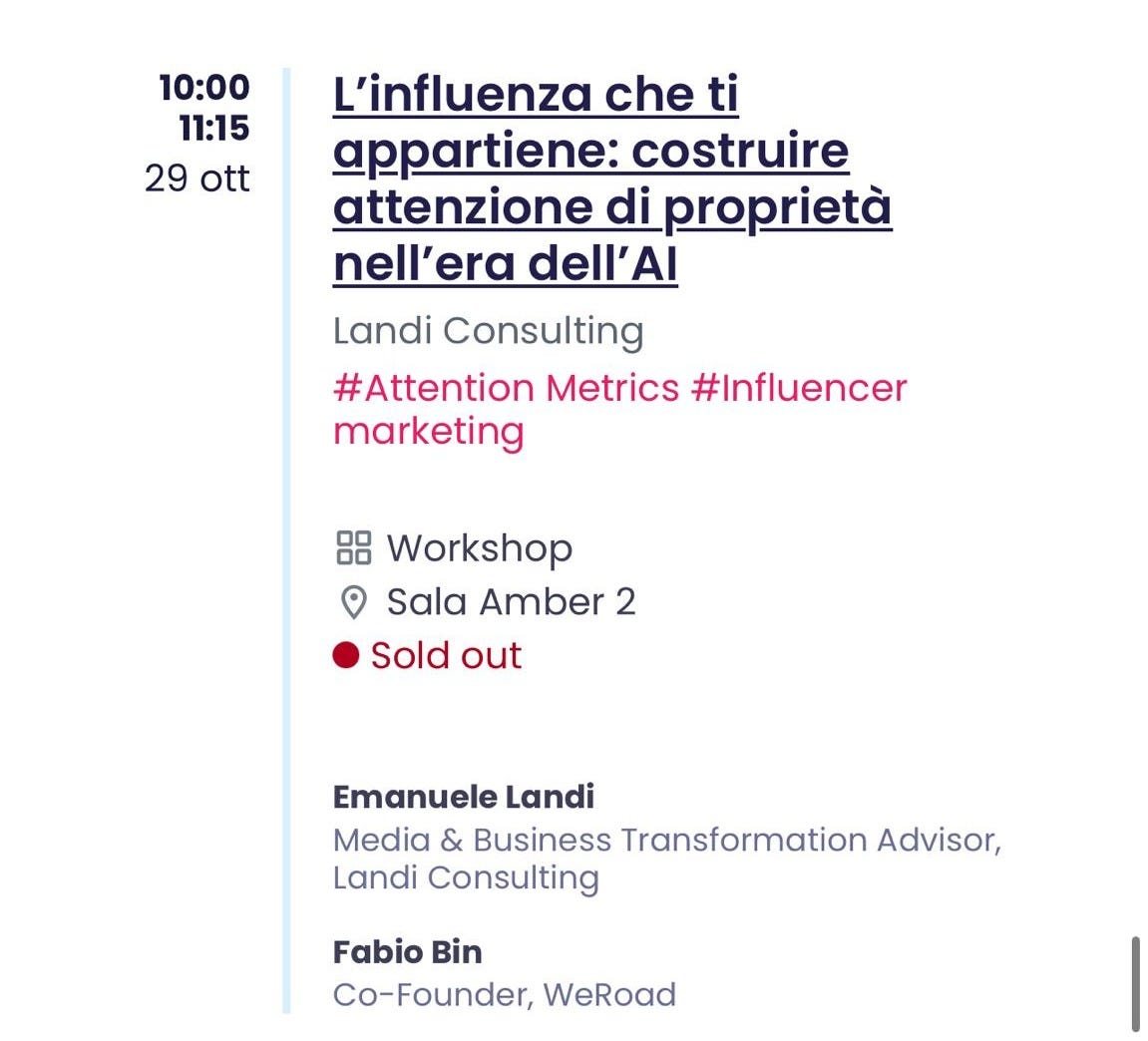
My Workshop “the influence that belongs to you” planned on 29th October at Intersections Festival in Milan is SOLD OUT. I will go through how I see monetization strategy through IPs. I will talk back some of these concepts for brands. See you there. If you don’t have access to the festival reach out I will be glad to give some accesses for free