

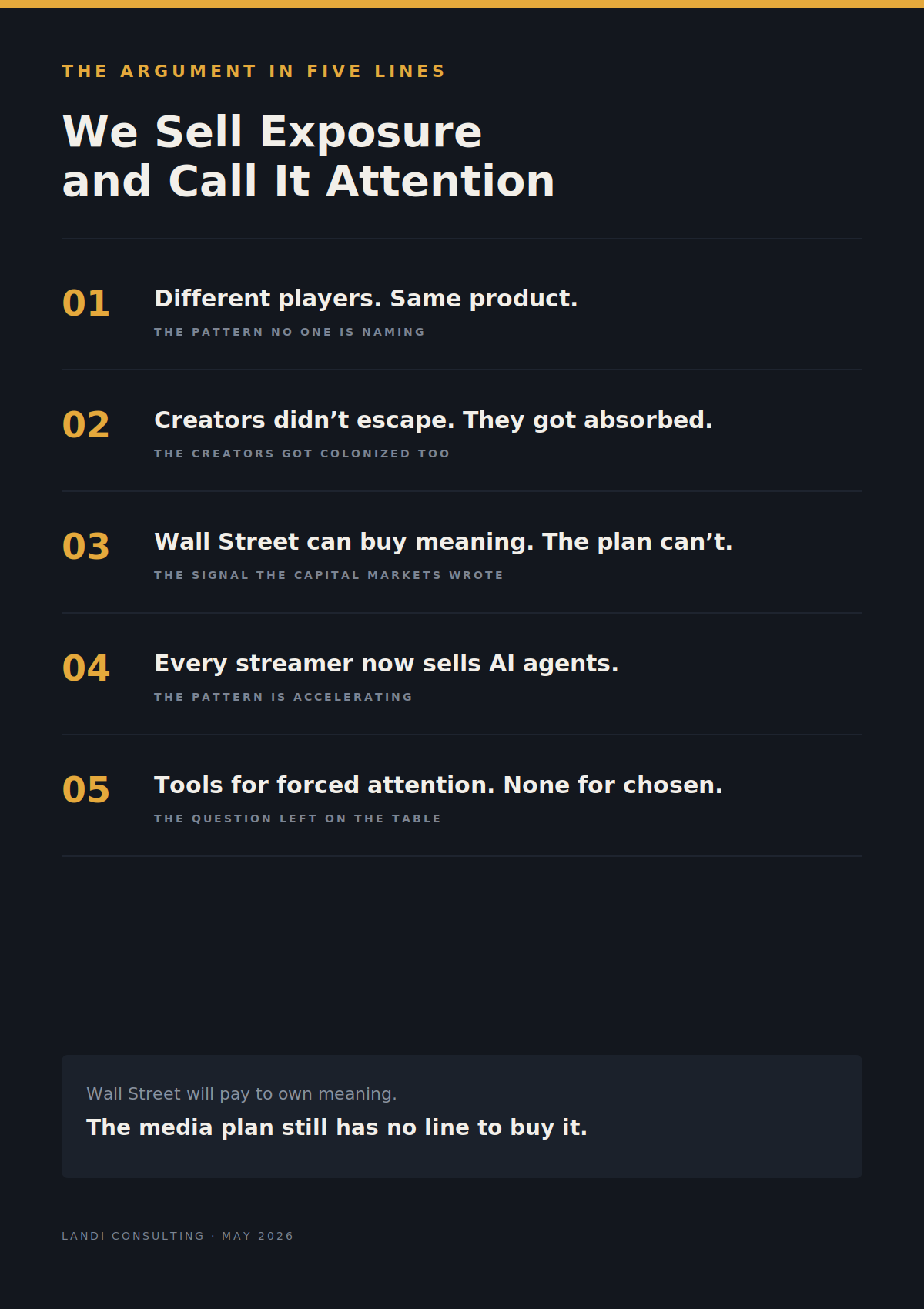
At Google Marketing Live 2026, the pitch to brands hardened a notch: with Ask Advisor — one Gemini agent fusing Ads, Analytics, Merchant Center and the Marketing Platform — you don’t need a media company to sell a toaster. You no longer need an agency, either. Google goes straight past attention to intention, with AI Mode now past a billion monthly users. But that’s still a sliver of the market. For everyone else, the industry still sells exposure and calls it attention. Even the creator economy, now $32 billion globally, has been absorbed into the same logic — while Wall Street has just paid close to five times revenue to own a brand built on meaning, exactly what the advertising system still can’t sell.
The product announcements were the wrapping: Ask Advisor, ad formats built for AI Mode, a Universal Cart, native checkout straight from the ad, Direct Offers fired at the high-intent moment. The subtext stayed constant — we’ll arrange the meeting between your product and the buyer who’s ready today, click by click. Need a video? Make it with AI. Need a creator? We have a library. Need a publisher? That’s an anachronism we’ll handle for you.
It’s an effective message, and it’s largely true. For the 5% of your potential buyers who are in-market right now and actively looking to purchase, Google and its peers are spectacular machines — granular, measurable down to the millimeter. The problem is the other 95%. And the way the system is trying to sell it.
The pattern no one is naming
Different players, same product: forced exposure plus a measurement layer. The 30-second spot didn’t die — it got refinanced.
Lift your eyes from the Google announcement to the wider landscape and a pattern emerges that’s worth naming explicitly, because I haven’t yet heard it framed the way it should be.
Every major player in video advertising — old and new — has converged on the same underlying model: forced exposure plus a proprietary measurement layer. The forcing is the heart of it. It’s interruption made mandatory by the mechanics of consumption: the pre-roll you can’t skip, the ad that fires when you hit pause, the video the feed slots between one piece of content and the next. The difference between players isn’t structural, it’s a matter of degree — targeting granularity, attribution precision, and how hard the forcing pushes: from the live ad you can’t skip, to the pause-screen ad, to the in-feed video you can scroll past in a second. The intensity varies; the nature doesn’t. Even the softest version is still an intrusion. And the product sold to the brand stays invariant: a message placed in front of a consumer who came for something else, made unavoidable enough — by the mechanics of the medium — to count as a view.
Google’s YouTube generated $40.4 billion in ad revenue in 2025, selling pre-roll and mid-roll. For scale: YouTube alone bills more than the entire global influencer marketing industry. Amazon’s Prime Video Ads bolts the 30-second spot onto its existing sponsored-search inventory, bridging exposure and shopper graph. Netflix, the last holdout, opened its ad-supported tier in 2022; it now reaches 250 million monthly active users, with ad revenue tracking toward $3 billion in 2026. Meta and TikTok sell in-feed video: forcing camouflaged inside the scroll. Linear TV, for its part, defends its territory with major live events — sports, award nights — where the forcing keeps a natural strength, because you can’t skip live.
What the system calls “advertising innovation” is really an upgrade to the measurement layer applied to a format that already existed. The 30-second spot isn’t dead; it’s been refinanced. Yet however much you optimize it, forced exposure remains a forcing — an intrusive model the mechanics of consumption make mandatory, and one the industry keeps refining instead of rethinking.
The creators got colonized too
Creators didn’t escape the system — they got absorbed by it. Two-thirds of the budget surge is performance money rebadged.
A CMO might object: but we invest in creators, and that isn’t forcing, it’s authenticity. You do invest. Let’s look at how.
The global influencer marketing industry was worth roughly $32.55 billion in 2025, up from about $24 billion in 2024. Fifty-four percent of multinational brands planned to raise creator spend (WFA). Numbers that prove the creator economy is a structured reality. But it’s inside these numbers that the subtlest confirmation of the diagnosis sits.
CreatorIQ’s State of Creator Marketing report shows creator-partnership investment grew 171% year over year — but roughly two-thirds of that increase came from reallocated paid media. It isn’t new money leaving the brand-building budget to build something different: it’s performance money, shifted onto creators because creator content has become a more efficient performance channel. CreatorIQ calls this phase the “Era of Efficacy,” describing the integration of creators with “the same performance-validation expectations as a media buy.”
Creators didn’t enter the budget as co-authors of brand meaning. They entered as more authentic performance units, measured on the conversion funnel. There’s a distinction the system is losing: one thing is paying a creator to talk about your product inside their content — camouflaged exposure, performance-driven; another thing is when the creator and the brand are one and the same, and the product is itself the content people choose to consume. That second case happens almost only when the brand is founded by the creator. The advertising market knows how to monetize the first, to the tune of $32 billion a year. The second, it still doesn’t know how to buy.
The signal the capital markets already wrote
Capital markets know how to value meaning once it becomes a company. The advertising market still can’t sell it as a line on the plan.
On May 28, 2025, e.l.f. Beauty — an NYSE-listed mass-market brand with $1.3 billion in revenue — agreed to acquire rhode, a three-year-old skincare brand with ten products total, founded by Hailey Bieber, in a deal worth up to $1 billion: $800 million at closing plus a $200 million earnout, against rhode’s $212 million in trailing revenue — close to 5x. The acquisition closed in August 2025, and on e.l.f.’s own guidance rhode is tracking toward roughly +70% net-sales growth in fiscal 2026.
The type of transaction is worth dwelling on. e.l.f. didn’t buy a product placement inside a piece of Hailey Bieber’s content; it bought the brand she is, in its entirety. A good share of that multiple is growth — rhode is expanding fast. But part of it pays for something a CFO still files under “intangible”: cultural authority built not through forced exposure or paid creator content, but through the narrative construction of a brand that is itself entertainment, part of the feed of the people who follow it. The paradox is the gap. Capital markets will pay close to 5x revenue to own a brand built on meaning, while the advertising market still can’t tell a CMO how to buy the same quality of meaning as a media placement.
The same signal is appearing beyond beauty, and beyond the US. In May 2026, Airbnb led a €49 million round in WeRoad, an Italian travel company built on community rather than on bought reach — capital backing a business whose growth comes from belonging, not from exposure.
There’s a structural disconnect between what the capital markets recognize as asset value and what the advertising market knows how to measure and buy as placement. Wall Street has understood what brand-as-meaning is worth as an acquirable asset. The advertising system hasn’t yet understood how to sell it as placement. And CMOs sit in the middle, with a single vocabulary to justify the spend: that of forced exposure, dressed up as a creator when needed.
The pattern isn’t just holding — it’s accelerating
Every streamer now sells AI agents that plan and buy. The product underneath hasn’t moved — forced exposure, just automated.
At the 2026 upfronts, which wrapped in mid-May, every major streaming player — Netflix, Disney, Amazon, NBCUniversal, Warner Bros. Discovery, Paramount, Fox — announced its own AI agents to help advertisers plan and buy campaigns. It’s the natural evolution of Google’s message: after “you don’t need a media company,” now you don’t need an agency. The tool that decides how much, where and how to buy inventory is being absorbed by the platform that sells that inventory. What stays invariant beneath the automated layer — beneath AI agents, authenticated audience graphs, clean rooms, shoppable carousels — is the product: forced exposure, measured well.
You can see it in the emerging formats too. Netflix launched a vertical feed inside its app in 2025, to compete with the scroll experience of TikTok and Reels. At the 2026 upfront it announced that ads are coming to it. The space that seemed like it might open a different grammar, inside the premium product par excellence, was immediately folded back into ad insertion. When a new format is born, the system applies the sales grammar it already knows — because it’s the only one its own AdOps and the advertiser’s procurement know how to handle at the moment of purchase.
And here is the part the streamers themselves should sit with. They hold the strongest cards in the system: powerful exposure, premium IP, low ad clutter, a direct and intimate relationship with the viewer on the couch. What they don’t yet hold is a different kind of attention. The big screen scores well on the existing attention vendors — Adelaide, TVision, Lumen — because the medium captures eyes; but what those scores measure is attention to an interruption, and the format innovations the streamers tout, from sponsored pause ads onward (Hulu got there first), are innovations of interruption, not new models of attention. The frontier isn’t a cleverer way to interrupt. It’s effective attention: exposure aligned with what the viewer actually cares about, measured on response rather than on delivery. The streamers have the assets to build it; for now the cash incentive keeps them optimizing the old model. But it’s there, in that unoccupied space, that the next cycle will be decided — and it deserves a piece of its own.
The question left on the table
CMOs have great tools for forced attention, none for the chosen kind. Whoever builds that grammar takes the next cycle.
CMOs live a dilemma the system doesn’t help them solve. They have to balance performance and brand. They have exquisite tools to measure and optimize performance — the entire forced-exposure market, from YouTube’s $40 billion to creator marketing’s $32 billion, now with AI agents that plan and buy on their behalf, is at their service. What they lack is a way to assess the investments that build brand through chosen attention rather than imposed attention. So they move brand budget around like a short blanket — pulling it from one medium to the next to sell a little more this quarter — and pour their ingenuity into optimizing interruptive attention, instead of a model that exists but doesn’t yet scale.
And this isn’t the same as the attention vendors the trade already knows. Lumen, Adelaide, TVision and the rest are real, but they sit as paid add-ons bolted onto the same interruptive buy, gauging how much of a forced impression actually landed. The shift I mean is upstream of that, and cultural: treating attention as alignment with what an audience genuinely cares about. Nor is it a luxury for beauty and travel brands. Nothing stops an insurer, or any “unglamorous” category, from building a real cultural connection — the constraint was never the category, it’s that no one yet knows how to buy or measure the connection once it’s built.
Wall Street has already shown what a brand built on meaning is worth to own: close to five times revenue. The advertising system still doesn’t know how to sell the same thing as placement.
The diagnostic question I’ll close on — and the one that opens the next chapter — isn’t which platform will win. It’s another: who will build the measurement-and-buying grammar that lets value built on chosen attention be treated as an asset, rather than sponsored as one more optimized forcing? Because until that grammar exists, the system will keep selling the old thing with better metrics — calling it, each time, innovation.
___________________
Vendiamo esposizione, la chiamiamo attenzione
A Google Marketing Live 2026, il pitch ai brand si è indurito di un grado: con Ask Advisor — un unico agente Gemini che fonde Ads, Analytics, Merchant Center e Marketing Platform — non ti serve una media company per vendere un tostapane. E non ti serve nemmeno un’agenzia. Google passa dritto dall’attenzione all’intenzione, con AI Mode che ha appena superato il miliardo di utenti mensili. Ma quello è ancora una fetta del mercato. Per tutto il resto, il settore continua a vendere esposizione e a chiamarla attenzione. Persino la creator economy, ora a 32 miliardi di dollari globali, è stata risucchiata dentro la stessa logica — mentre Wall Street ha appena pagato quasi cinque volte i ricavi per possedere un brand costruito sul significato, esattamente ciò che il sistema pubblicitario ancora non sa vendere.
Gli annunci di prodotto erano la confezione: Ask Advisor, formati pubblicitari costruiti per AI Mode, un Universal Cart, native checkout direttamente dall’annuncio, Direct Offers sparate nel momento di alta intenzione. Il sottotesto è rimasto identico — l’incontro tra il tuo prodotto e il consumatore pronto a comprare oggi lo organizziamo noi, click dopo click. Ti serve un video? Lo fai con l’AI. Ti serve un creator? Abbiamo una libreria. Ti serve un publisher? È un anacronismo, ce ne occupiamo noi.
È un messaggio efficace, e in larga parte vero. Per quel 5% di potenziali acquirenti già in mercato, attivamente alla ricerca dell’acquisto, Google e i suoi pari sono macchine spettacolari — granulari, misurabili al millimetro. Il problema è l’altro 95%. E il modo in cui il sistema sta provando a venderlo.
Il pattern che nessuno sta nominando
Giocatori diversi, stesso prodotto: esposizione forzata più uno strato di misurazione. Lo spot da 30 secondi non è morto — è stato rifinanziato.
Alza lo sguardo dall’annuncio di Google al panorama più ampio e uno schema emerge che vale la pena nominare esplicitamente, perché non l’ho ancora sentito incorniciato nel modo in cui dovrebbe esserlo.
Ogni grande player della pubblicità video — vecchio o nuovo — è convergito sullo stesso modello di fondo: esposizione forzata più uno strato di misurazione proprietario. La forzatura è il cuore della cosa. È interruzione resa obbligatoria dalla meccanica del consumo: il pre-roll che non puoi saltare, l’annuncio che parte quando metti in pausa, il video che il feed infila tra un contenuto e l’altro. La differenza tra i player non è strutturale, è una questione di grado — granularità del targeting, precisione dell’attribuzione, e quanto duramente la forzatura spinge: dall’annuncio live che non puoi saltare, al pause-screen, al video in-feed che puoi scrollare via in un secondo. L’intensità varia; la natura no. Anche la versione più morbida resta un’intrusione. E il prodotto venduto al brand resta invariante: un messaggio piazzato davanti a un consumatore arrivato per altro, reso abbastanza inevitabile — dalla meccanica del mezzo — da contare come una view.
YouTube di Google ha generato 40,4 miliardi di dollari di ad revenue nel 2025, vendendo pre-roll e mid-roll. Per dare la scala: YouTube da solo fattura più dell’intera industria globale dell’influencer marketing. Amazon Prime Video Ads incolla lo spot da 30 secondi al suo inventario sponsored-search già esistente, fondendo esposizione e shopper graph. Netflix, l’ultimo holdout, ha aperto il tier ad-supported nel 2022; oggi raggiunge 250 milioni di utenti mensili attivi, con ad revenue che traguarda i 3 miliardi di dollari nel 2026. Meta e TikTok vendono video in-feed: forzatura mimetizzata dentro lo scroll. La TV lineare, dal canto suo, difende il proprio territorio con i grandi eventi live — sport, premiazioni — dove la forzatura conserva una forza naturale, perché il live non lo puoi saltare.
Quella che il sistema chiama “innovazione pubblicitaria” è in realtà un upgrade dello strato di misurazione applicato a un formato che esisteva già. Lo spot da 30 secondi non è morto; è stato rifinanziato. Eppure, per quanto tu lo ottimizzi, l’esposizione forzata resta una forzatura — un modello intrusivo che la meccanica del consumo rende obbligatorio, e che il settore continua a raffinare invece che ripensare.
Anche i creator sono stati colonizzati
I creator non sono sfuggiti al sistema — sono stati assorbiti. Due terzi della crescita di budget è denaro performance riallocato.
Un CMO potrebbe obiettare: ma noi investiamo nei creator, e quella non è forzatura, è autenticità. Sì, investite. Vediamo come.
L’industria globale dell’influencer marketing valeva all’incirca 32,55 miliardi di dollari nel 2025, dai circa 24 miliardi del 2024. Il 54% dei brand multinazionali pianificava di aumentare la spesa sui creator (WFA). Numeri che dimostrano come la creator economy sia ormai una realtà strutturata. Ma è dentro questi numeri che siede la conferma più sottile della diagnosi.
Il report State of Creator Marketing di CreatorIQ mostra che l’investimento in partnership con creator è cresciuto del 171% anno su anno — ma circa due terzi di quell’incremento sono arrivati da paid media riallocato. Non è denaro nuovo che lascia il budget brand-building per costruire qualcosa di diverso: è denaro performance, spostato sui creator perché il contenuto creator è diventato un canale performance più efficiente. CreatorIQ chiama questa fase “Era of Efficacy”, descrivendo l’integrazione dei creator con “le stesse aspettative di validazione performance di un media buy”.
I creator non sono entrati nel budget come co-autori di significato di marca. Sono entrati come unità di performance più autentiche, misurate sul funnel di conversione. C’è una distinzione che il sistema sta perdendo: una cosa è pagare un creator perché parli del tuo prodotto dentro il suo contenuto — esposizione mimetizzata, performance-driven; un’altra cosa è quando il creator e il brand sono la stessa cosa, e il prodotto è il contenuto stesso che le persone scelgono di consumare. Quel secondo caso accade quasi solo quando il brand è fondato dal creator. Il mercato pubblicitario sa come monetizzare il primo, fino a 32 miliardi l’anno. Il secondo, non sa ancora come comprarlo.
Il segnale che il mercato dei capitali ha già scritto
Il mercato dei capitali sa valutare il significato quando diventa un’azienda. Il mercato pubblicitario ancora non sa venderlo come riga di piano.
Il 28 maggio 2025, e.l.f. Beauty — brand mass-market quotato al NYSE con 1,3 miliardi di dollari di ricavi — ha accettato di acquisire rhode, un brand skincare di tre anni con dieci prodotti in tutto, fondato da Hailey Bieber, in un’operazione del valore fino a 1 miliardo di dollari: 800 milioni alla chiusura più un earnout da 200 milioni, contro i 212 milioni di dollari di trailing revenue di rhode — vicino a 5x. L’acquisizione si è chiusa ad agosto 2025, e sulla guidance di e.l.f. stessa rhode è in traiettoria per una crescita di circa +70% delle net sales nell’anno fiscale 2026.
Il tipo di transazione merita di essere soppesato. e.l.f. non ha comprato un product placement dentro un pezzo di contenuto di Hailey Bieber; ha comprato il brand che lei è, nella sua interezza. Una buona parte di quel multiplo è crescita — rhode si sta espandendo veloce. Ma una parte paga per qualcosa che un CFO ancora archivia sotto “intangibile”: l’autorità culturale costruita non attraverso esposizione forzata né contenuto creator a pagamento, ma attraverso la costruzione narrativa di un brand che è esso stesso intrattenimento, parte del feed delle persone che lo seguono. Il paradosso è il vuoto. Il mercato dei capitali pagherà quasi 5x i ricavi per possedere un brand costruito sul significato, mentre il mercato pubblicitario ancora non sa dire a un CMO come comprare la stessa qualità di significato come placement.
Lo stesso segnale sta apparendo oltre il beauty, e oltre gli USA. Nel maggio 2026, Airbnb ha guidato un round da 49 milioni di euro in WeRoad, una compagnia di viaggi italiana costruita sulla comunità più che sul reach comprato — capitale che scommette su un business la cui crescita arriva dall’appartenenza, non dall’esposizione.
C’è una disconnessione strutturale tra quello che il mercato dei capitali riconosce come valore asset e quello che il mercato pubblicitario sa misurare e comprare come placement. Wall Street ha capito quanto vale brand-as-meaning come asset acquisibile. Il sistema pubblicitario non ha ancora capito come venderlo come placement. E i CMO siedono nel mezzo, con un solo vocabolario per giustificare la spesa: quello dell’esposizione forzata, vestita da creator quando serve.
Il pattern non sta solo tenendo — sta accelerando
Ogni streamer ora vende agenti AI che pianificano e comprano. Il prodotto sotto non si è mosso — esposizione forzata, solo automatizzata.
Agli upfront 2026, conclusi a metà maggio, ogni grande player streaming — Netflix, Disney, Amazon, NBCUniversal, Warner Bros. Discovery, Paramount, Fox — ha annunciato i propri agenti AI per aiutare gli inserzionisti a pianificare e comprare campagne. È la naturale evoluzione del messaggio di Google: dopo “non ti serve una media company”, adesso non ti serve nemmeno un’agenzia. Lo strumento che decide quanto, dove e come comprare inventory viene assorbito dalla piattaforma che vende quell’inventory. Quello che resta invariante sotto lo strato automatizzato — sotto agenti AI, grafi di audience autenticate, clean room, caroselli shoppable — è il prodotto: esposizione forzata, ben misurata.
Lo vedi anche nei formati emergenti. Netflix ha lanciato nel 2025 un feed verticale dentro la sua app, per competere con l’esperienza scroll di TikTok e Reels. All’upfront 2026 ha annunciato che gli ad stanno arrivando anche lì. Lo spazio che sembrava potesse aprire una grammatica diversa, dentro il prodotto premium per eccellenza, è stato immediatamente ripiegato dentro l’ad insertion. Quando nasce un nuovo formato, il sistema gli applica la grammatica di vendita che conosce già — perché è l’unica che il suo AdOps e il procurement dell’advertiser sanno gestire nel momento dell’acquisto.
E qui c’è la parte con cui gli streamer stessi dovrebbero fare i conti. Hanno in mano le carte più forti del sistema: esposizione potente, IP premium, basso clutter pubblicitario, una relazione diretta e intima con lo spettatore sul divano. Quello che ancora non hanno è un tipo diverso di attenzione. Il grande schermo punteggia bene sui vendor di attenzione esistenti — Adelaide, TVision, Lumen — perché il mezzo cattura gli occhi; ma quello che quei punteggi misurano è attenzione a un’interruzione, e le innovazioni di formato che gli streamer sbandierano, dalle sponsored pause ads in poi (Hulu è arrivato per primo), sono innovazioni dell’interruzione, non nuovi modelli di attenzione. La frontiera non è un modo più intelligente di interrompere. È attenzione efficace: esposizione allineata con ciò a cui lo spettatore tiene davvero, misurata sulla risposta più che sulla delivery. Gli streamer hanno gli asset per costruirla; per ora l’incentivo cash li tiene a ottimizzare il modello vecchio. Ma è lì, in quello spazio non occupato, che si deciderà il prossimo ciclo — e merita un pezzo a sé.
La domanda lasciata sul tavolo
I CMO hanno ottimi strumenti per l’attenzione forzata, nessuno per quella scelta. Chi costruirà quella grammatica si prende il prossimo ciclo.
I CMO vivono un dilemma che il sistema non li aiuta a risolvere. Devono bilanciare performance e brand. Hanno strumenti raffinati per misurare e ottimizzare la performance — l’intero mercato dell’esposizione forzata, dai 40 miliardi di YouTube ai 32 della creator economy, ora con agenti AI che pianificano e comprano per conto loro, è a loro disposizione. Quello che manca è un modo per valutare gli investimenti che costruiscono brand attraverso attenzione scelta invece che attenzione imposta. Quindi spostano il budget di brand come una coperta corta — tirandolo da un mezzo all’altro per vendere un po’ di più questo trimestre — e versano la loro ingegnosità nell’ottimizzare l’attenzione interruttiva, invece che su un modello che esiste ma non ha ancora scala.
E questo non è la stessa cosa dei vendor di attenzione che il mercato conosce già. Lumen, Adelaide, TVision e gli altri sono reali, ma siedono come add-on a pagamento bullonati sopra lo stesso acquisto interruttivo, misurando quanto di un’impression forzata è effettivamente atterrato. Lo shift di cui parlo io è a monte, ed è culturale: trattare l’attenzione come allineamento con quello a cui un’audience tiene davvero. E non è un lusso per brand di beauty e travel. Niente impedisce a un’assicurazione, o a qualsiasi categoria “poco glamorous”, di costruire una connessione culturale vera — il vincolo non è mai stato la categoria, è che nessuno ancora sa come comprare o misurare quella connessione una volta che è stata costruita.
Wall Street ha già mostrato quanto vale possedere un brand costruito sul significato: quasi cinque volte i ricavi. Il sistema pubblicitario ancora non sa come vendere la stessa cosa come placement.
La domanda diagnostica con cui chiudo — e quella che apre il prossimo capitolo — non è quale piattaforma vincerà. È un’altra: chi costruirà la grammatica di misurazione e di acquisto che permetterà al valore costruito sull’attenzione scelta di essere trattato come un asset, invece di essere sponsorizzato come l’ennesima forzatura ottimizzata? Perché finché quella grammatica non esiste, il sistema continuerà a vendere la stessa vecchia cosa con metriche migliori — chiamandola, ogni volta, innovazione.