

Advertising still buys attention in other people’s rooms. The brands that matter next will not only rent but they will build a room of their own: a media. That was the argument of my workshop at IAB Italia’s Intersections in Milan on 29 October.
It starts with a question I asked the room: where do you watch your favorite content? For a large share of under-35s the honest answer is the bathroom. In a June 2026 US survey by Evan Shapiro with MX8 Labs, about 40% of 18-24s ranked the toilet among their top three places to watch video regularly, and more than a third of 25-34s did the same (source; one survey, US only, sample size not stated). The living room that most advertising was designed for is no longer where the relationship with content forms.
The problem: a thousand fiefs, and the market chose push
There are too many rooms. YouTube says it receives more than 20 million videos a day (company-declared). vidIQ counts about 4.8 million channels with 10,000+ subscribers, out of 61 million. Europe alone has 9,639 linear TV channels (EAO/MAVISE, December 2025), almost four in ten local. Each one is a fief with its own audience, language and rules, and a 30-second spot enters each as a stranger.
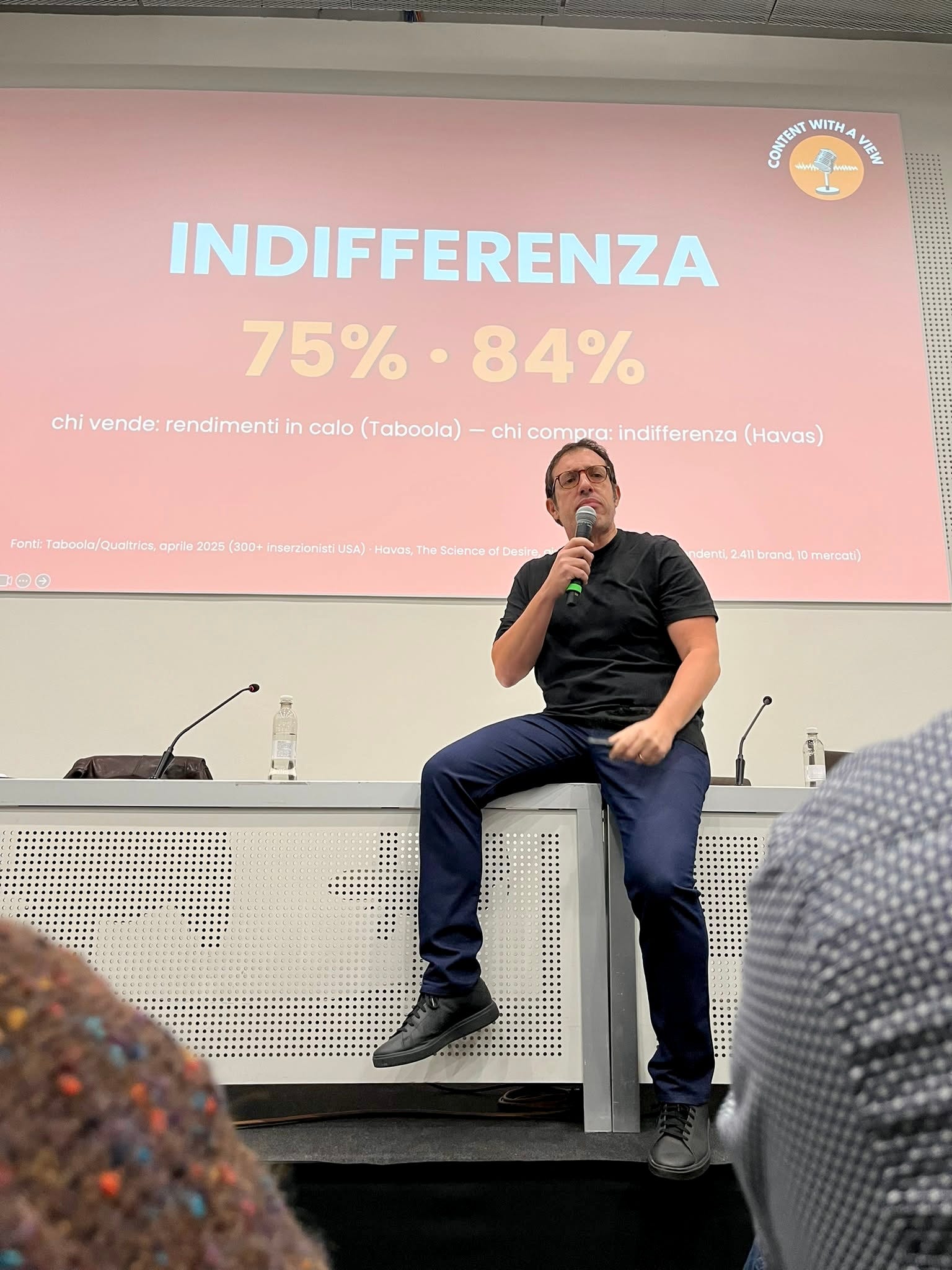
Both sides of the market say it is not working. In a Taboola/Qualtrics survey of 300+ US advertisers (April 2025), 75% of performance marketers reported diminishing returns on their social spend. On the other side, Havas’s Science of Desire (June 2026; 87,551 respondents, 2,411 brands, 10 markets) puts 84% of brands in the middle of its desire scale, which Havas labels indifference.
The market’s answer was rational: if building a relationship in a thousand fiefs is slow and hard, skip it and sell. IAB/PwC data show 67.1% of US digital ad revenue was sold on performance pricing in 2020, up from 61.8% in 2018. IAB stopped publishing that split, so this is the most recent official figure I could find: dated, US-only, and a measure of how ads are sold, not of marketing budgets. It shows a direction, not the present level. Add AI, which makes targeting and production cheaper, and the push keeps getting easier.
What changes: relationship is influence, influence is money
Performance accelerates conversion. It does not build what produces it. Two cases sit on opposite sides.
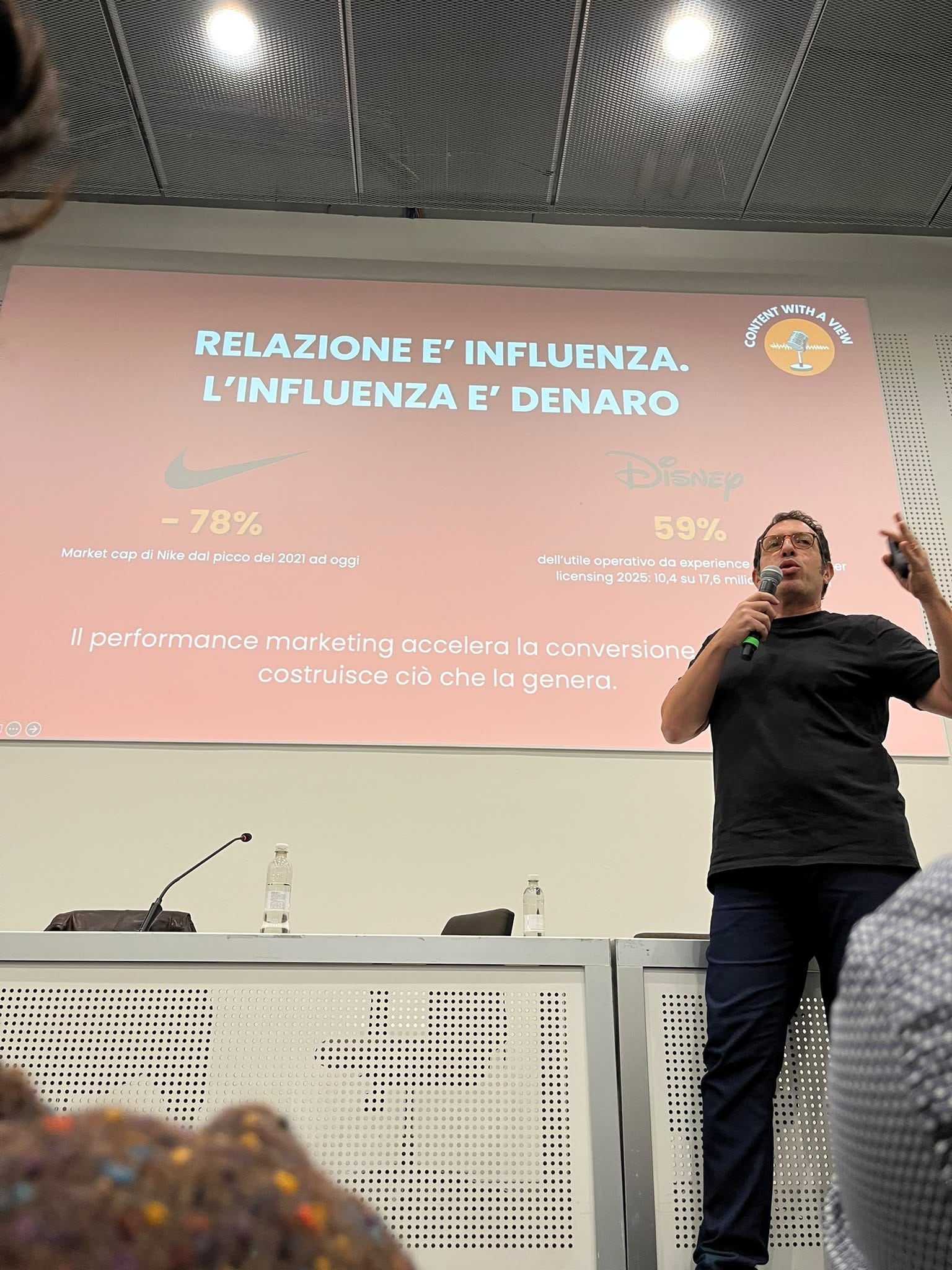
Nike sold belonging, not shoes. It leaned hard into performance and direct channels, and in December 2024 CEO Elliott Hill said he would shift dollars from performance back to brand marketing. Nike’s market cap is down about 78% from the end of 2021 to late October 2026, and revenue fell from $51.4bn in fiscal 2024 to $46.4bn in fiscal 2026 (-9.7%, my calculation). The decline has many causes (China, the wholesale pullback, the product pipeline, tariffs). I am not claiming performance marketing caused it; I am pointing at a company that says it overcorrected.
Disney lives on belonging. In fiscal 2025, Experiences ($10.0bn operating income) plus Content Sales/Licensing ($0.4bn) made up 59% of segment operating income, $10.4bn of $17.6bn. That share was 68% in fiscal 2023 and has fallen because streaming turned profitable, not because the parks shrank. Disney does not attribute these profits to fandom; that reading is mine.
The tool that changed who can build this is the creator economy. It moved relationships from one-to-many to one-to-one: people with a camera built communities, then personal IP, then businesses. Media companies that own their IP have always run on the same loop (build an audience with programs, then monetize the IP). Now a brand can run it too.
Three cases, each closing the loop differently, each with limits:
• Duolingo. Revenue went from $251M (2021) to about $1.03bn (2025), with marketing steady near 12% of revenue. TikTok grew from 50,000 to 16M+ followers in about four years, run in-house. The channel does not sell directly: it feeds the app. Merchandising has run since about 2022 and the company calls its sales secondary to brand love. How much the owl is worth is undisclosed.
• Sidemen. A YouTube group (2013) that added merchandising in 2014, Sides in 2021, a vodka and a paid fan club in 2022. 22M+ subscribers.
• WeRoad. Group travel with strangers, run by 4,000+ coordinators. 2025 revenue of EUR 130M (+30%, company-declared), 300,000+ travelers since launch, and a $58M round led by Airbnb in May 2026. WeRoad still buys third-party media: metro posters in Milan in 2022, London Underground and buses in 2023 with real travelers’ selfies. The rented media invites people in; the community is what they join.
One honest note on speed. The first licence is not faster than before: Disney licensed Mickey a year after launch in 1929, as the Sidemen did with merchandise. What shortened is the time to the first owned business without intermediaries (Disneyland came 27 years after Mickey), and who has access to it.
How a brand does it: five moves
Becoming a media means changing what you are: not a creator, not an influencer to rent, but a system that outlives its faces. A creator is a person; a media is a format, a cadence and an audience that returns, owned by the brand and not by whoever performs it. A brand with no face creates no relationship (nobody talks to a logo), but a face alone leaves when it tires or asks for more money. You need both.
1. Control is not agency. Keep control (safety, quality, brand, margins). Give up agency: who interprets the product and tells its story in culture.
2. Democratic, not perfect. A brand that cannot cede agency stays flawless and useless.
3. A weirdo system. Creators say out loud the odd habits and obsessions people used to keep private, and that is where belonging starts. The brand finds its face there, even if the face is an owl. Quality does not die; it gets rare and expensive.
4. Format and IP you own. A name, rules, a cadence, recurring characters, able to continue with other people inside. Cadence creates repeated listening, and repeated listening creates the relationship. The test: what is left when the person leaves?
5. Follow the IP to the money. A relationship you do not monetize is a hobby. Two roads exist: belonging, relationship, IP, brand, money (the creator’s road), or brand, IP, media, money (the company’s). Either way you monetize the audience directly (products, subscriptions, merchandise) or indirectly, by selling better what you already sell. And keep one line clear: declared data, given by a person with a reason to give it, builds the relationship; inferred data, taken without their noticing, eventually burns it.
On AI, two jobs. The first is to transform renting, not abandon it. Every time a brand borrows someone else’s reach, it enters a fief with its own language, context and moment: a creator’s audience, a streaming ad break, a local TV channel, a phone in the bathroom. One message fits none of them. AI can absorb the complexity that made tailoring impractical: process (adapting and versioning creative), scale (thousands of variants), analysis (reading what each context rewards) and selection (choosing which version runs where). Coca-Cola says its 2025 holiday ad took a month instead of a year, with AI generating more than 70,000 clips that artists then refined; Klarna says it cut its image cycle from six weeks to seven days (both company-declared). Those claims show production scale, not yet context fit: I found no verified case of AI tailoring rented-media creative with measured results. The test is not the saving but whether the rented media works as an invitation into the brand’s own.
The second job. AI has also made push easier, so use it on the other side: listening. A media lives on what its audience returns. AI can read ten thousand comments, find themes and draft replies; humans keep the relationship, moderate and decide the boundaries. Unilever says it uses AI to read social signals across languages, and Klarna, Coca-Cola and Mondelez report large cuts in production time or cost (all company-declared, none independently verified). I found no verified case of a brand generating its own IP or format with AI. The opportunity is more content in less time, not the same content for less money. Fabio Bin said something interesting about AI use in Weroad: they let employees create their own AI flow to optimize their work so general rule, objective but individual effort. This is something AI was born for: an individual machine to make people work better not on their behalf.
“This only works for young digital brands”
The objection I hear most: fine for start-ups, but not for legacy brands with a structured identity. I think it runs the other way. A legacy brand has more history, more assets and more values to turn into IP and connection than a start-up ever will. Disney, whose Mickey dates to 1928, is the clearest case. The Michelin Guide, published since 1900, is a media built by a tire maker (general knowledge, not checked for this piece). I saw it at small scale myself: with illy, about fifteen years ago, the hidden asset, the coffee supplied to city bars, became a TV series about the people serving the product, and a B2B business became a brand.
What stops legacy brands is not assets but control. The model asks them to give agency to the people who use the brand, interpret it and tell its story, while keeping control of safety, quality, trademark and margins. Structured brands tend to confuse the two, and that is a governance problem, not a creative one.
To be fair: Duolingo, the Sidemen and WeRoad are all young, and I have no verified example of a legacy consumer brand running a monetized media of its own. The case for legacy brands is an argument from assets, not from results.
What this does and does not say
I am not telling anyone to abandon reach. Good reach campaigns stay, and the IPA’s Binet and Field research says reach is what recruits new audiences. The change is that a brand which only rents attention starts from zero every time and leaves nothing behind. Building an audience of its own, one that participates, lets it capitalize that audience when it buys reach. Traditional media do not die: they become instrumental to the business model, not its primary tool. WeRoad’s posters are the example.
No study shows that an owned audience beats reach. The three cases show a sequence, not a return. That is why I would test it small before restructuring anything.
You can see where you stand with the free Owned Attention Test (nine questions) at contentwithaview.com. You can Go also for the Afterlife test. https://www.contentwithaview.com/i/217043115/the-afterlife-test-how-to-know-if-a-brand-partnership-was-worth-it
if the face left tomorrow, what would remain: the format, the audience, the community, or nothing? And in case you want more you can check your content efficacy with my agent Brand comms score (DM me for a free try).
Here you can download the keynote with all numbers and research made.
Sources
• Evan Shapiro, From the couch to the toilet (June 2026)
• YouTube for Press; vidIQ (July 2026); EAO/MAVISE (December 2025)
• Taboola/Qualtrics (April 2025); Havas, The Science of Desire (June 2026)
• IAB/PwC Internet Advertising Revenue Report (2018-2020)
• Nike FY2024-FY2026 annual results and the December 2024 earnings call; CompaniesMarketCap (market cap, 22 October 2026)
• Disney 8-K, 13 November 2025 (fiscal 2025 segment results)
• Duolingo 10-K (FY2025), shareholder letters, Modern Retail (22 August 2024), The Drum (25 February 2025)
• Wikipedia, Tubefilter and City AM on the Sidemen; Quality Travel (11 August 2022), NI Travel News (2 March 2023), Maddyness (13 October 2022), Teleborsa and QuiFinanza (27 May 2026), Startmag on WeRoad
• Consumer Goods Technology (3 July 2025), Marketing Dive (29 May 2024), The Decoder (4 November 2025), Reuters via NACS (27 October 2025)