

Welcome back. While most of us was on vacation Netflix and Youtube started knocking the stuffing out of each other.
YouTube just doubled the thresholds for its Partner Program: starting February 1, 2027, creators will need 8,000 watch hours a year or 20 million Shorts views in 90 days — double the previous bar. That same month, Netflix added the Stokes Twins to its roster of non-exclusive creator deals, following Ms. Rachel, Mark Rober, the Sidemen, Rhett & Link, and Nick DiGiovanni. And on August 19, Bloomberg revealed the third move: YouTube is offering its top creators multi-million-dollar packages — direct show financing, a cut of brand deals negotiated on-platform, upfront cash — just to buy exclusivity windows and keep them away from Netflix; anyone who signs with Netflix anyway risks being cut out of marketing campaigns, corporate events, and ad-revenue splits. Three moves that look unrelated. They aren’t. It’s the same war fought on three fronts.
The thesis is simple, and I stand by it: addiction sells, and it sells because it makes revenue predictable. Scrolling delivers a higher retention dividend than binge-watching, regardless of content quality, because it turns consumption into a recurring, potentially endless behavior — exactly like the low-cost filler programming that filled daytime TV forty years ago: cheap to produce, good at keeping you company. Binge-watching was the taboo streaming broke, flooding subscribers with dopamine on a subscription. Scroll is its evolution — an avalanche of dopamine built for the age of continuous ad harvesting. And capital knows it: in the second quarter of 2026, for the first time, all five major streamers turned a profit simultaneously — Netflix posted $12.6 billion in revenue (+13%) and $3.4 billion in profit, Disney+/Hulu $5.5 billion (+11%) and $712 million in profit, even Peacock swung to a profit after a loss the year before. They’re not rewarding the best content. They’re rewarding the most predictable retention.
That’s exactly why streamers are opening their doors to the social model, and why YouTube knows it and is raising the barriers to entry right now. But not every opening carries the same weight. Netflix signing YouTube creators dilutes their native performance, but it does so behind a paywall — low replicability, since watching Ms. Rachel on Netflix still requires a subscription, and compulsive scrolling remains a behavior native to YouTube or TikTok, not to a premium catalog. Disney opening up to TikTok is a different story: it hands creators free access to Marvel, Pixar, and Star Wars — no subscription friction — while content born on TikTok now flows into Disney+’s new Verts section. Disney is handing TikTok exactly the fuel it lacked to attack YouTube on its own turf — free, native, viral — and paying for it, on top of everything, with creator labor that’s largely unpaid. If Netflix is building a second, paywalled living room, Disney is arming YouTube’s direct rival. Meanwhile, Disney itself is weighing a free, ad-supported tier to capture price-sensitive viewers, even as it has already sold out ad space for the next Super Bowl. The signal is unmistakable: subscription-based players are fast learning the grammar of those who live on free attention.
That said — someone else is footing this bill. Not YouTube, not the streamers: the brand doing the spending. Because the result is an inventory with pristine dashboards — massive reach, brutal frequency, ever-sharper CPMs — and distribution that keeps getting more personalized. But that personalization often stops at delivery: the machine knows exactly who to show the message to, while the message itself stays surprisingly standard. The same spot, better optimized and delivered with more precision. And the numbers back this up; it’s not just a hunch. A Taboola study of 300 advertisers found that 75% of performance marketers are seeing diminishing returns on social ad spend, hitting 30% of their budgets. eMarketer finds that among U.S. marketers, confidence in attention metrics is the lowest-scoring metric of all. Dashboards can stay pristine because they measure very well what the system makes observable — reach, frequency, conversions, behavioral signals — and far less a harder question few are willing to sit with: how much of that exposure was still capturing real attention, and how much was just an already-exhausted audience?
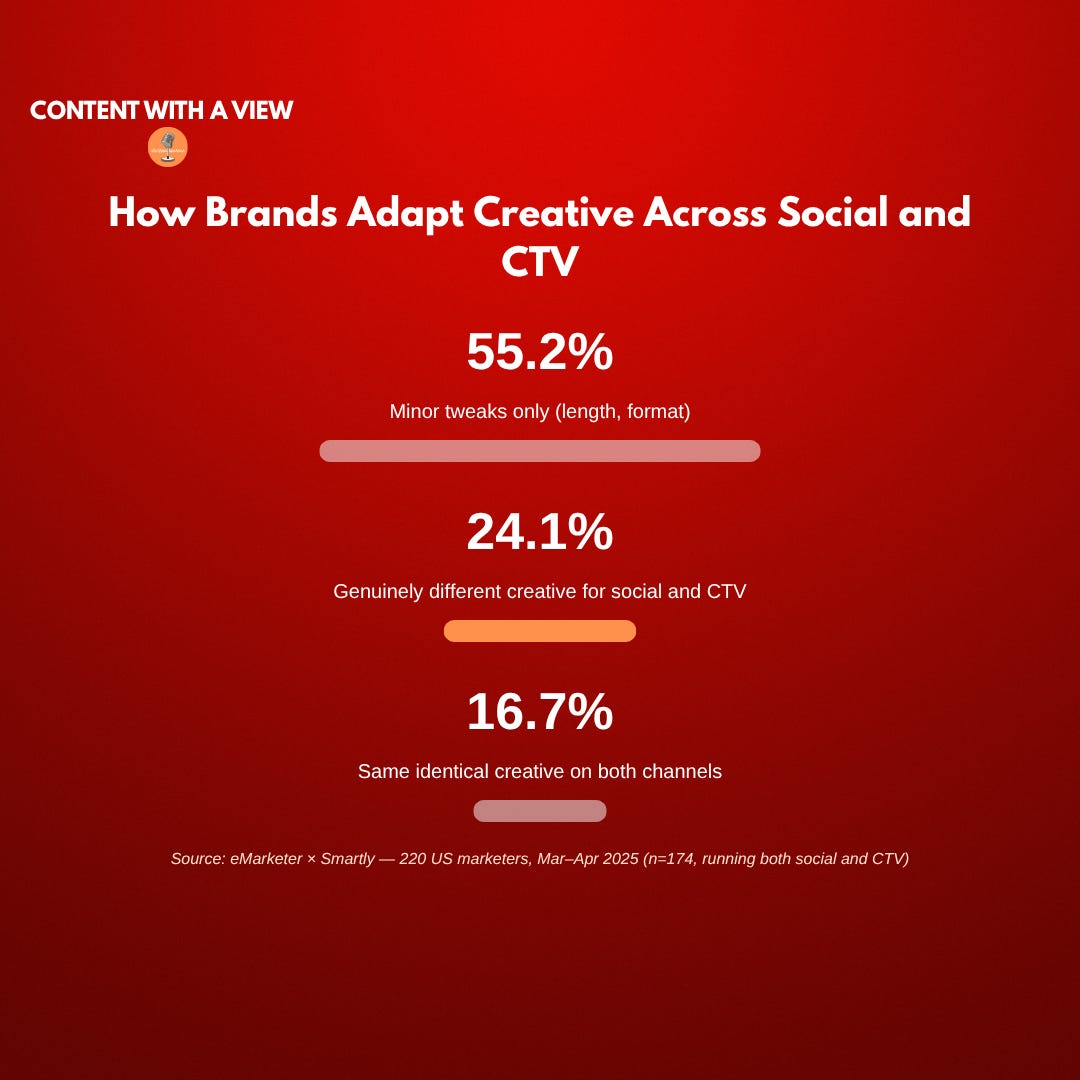
55.2% of US marketers running both social and CTV only make minor tweaks to their creative across the two channels. 16.7% run the exact same creative on both. Just 24.1% actually build something different. (Source: eMarketer × Smartly, 220 marketers, Mar–Apr 2025).
The real issue isn’t video length or aspect ratio. It’s that we still treat brand consistency as message repetition, when it should mean consistency of code — logo, tone, distinctive assets — not of content. A brand can wear a different outfit depending on where it meets you, because context now qualifies advertising instead of just hosting it.
Here’s what makes the “budget” excuse almost comedic: marketers cite the cost of producing multiple variants (47.3%) and budget (41.4%) as the top barriers to adapting creative — the same report confirms it. But generative AI is exactly what’s collapsing that cost curve. What’s missing isn’t technology, and increasingly it isn’t money either. It’s the will to stop treating context as an afterthought.
Most trade coverage frames this moment as a war for talent — who lands the next creator star, who wins the creator war. That’s not the point. The point is that brands are footing this war’s bill because they still haven’t figured out how to convert vertical dopamine into real effectiveness: they keep buying reach and affinity data to run the same broadcast spot they used to run on TV, just better distributed, or they rent a creator for a discount-code sponsorship — same ad, different wrapper. And it works, but it works almost only where direct response has always worked: highly convertible, functional products with no brand equity to build — a course, a gadget, an on-demand service. Not because exposure is easier to measure there, but because the creative itself is different: built to pay for itself in a few seconds — immediate demonstration, proof instead of promises, an explicit offer — not to carry a brand’s story forward. For an enterprise brand that has to build memory, preference, and meaning over time, the game is far more complex: either build messages with extreme creative personalization and context, native enough to belong in the user’s feed as if born there — not a repurposed spot, but new content — or stop renting someone else’s attention and start building an owned media and content strategy as autonomous and relevant as a creator’s: proprietary attention, not just borrowed. It’s the same logic I opened this piece with: capital rewards whoever owns predictable retention, not whoever rents it one CPM at a time. Scroll beats binge. But it only pays off for whoever owns the attention — not whoever buys it wholesale.