

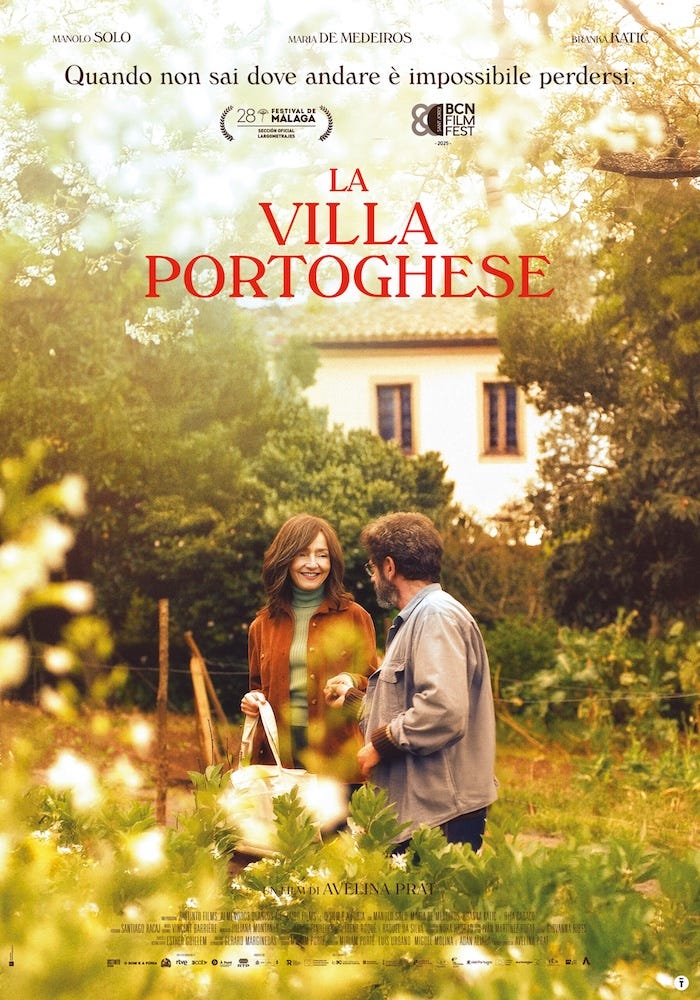
Mi scuso con i miei lettori. Esco ora con questa newsletter prima di quella tecnica di domani, ma ho avuto una urgenza dopo aver visto ieri al cinema un film di rara potenza ed intensità che mi ha toccato profondamente. Spero riusciate a recuperarlo
Ci sono film che guardi.
E poi ci sono film che, senza chiedere permesso, ti restano addosso.
La villa portoghese per me è stato questo.
Non perché racconti qualcosa di straordinario, ma perché mette in scena una verità semplice e spesso scomoda:
quando una frattura attraversa la tua vita, non torni più esattamente dove eri.
Puoi provarci.
Ma qualcosa è già cambiato.
Il protagonista è una persona “a posto”.
Una vita ordinata, riconoscibile, legittimata e di prestigio.
Poi accade qualcosa che rompe l’equilibrio in modo irreversibile. Un evento improvviso e non pianificato e soprattutto apparentemente inspiegabile ed ingiustificato.
Capita, ma quando diventa la spinta per interrogarsi e capire profondamente allora lì inizia la vera avventura.
Da lì in poi, la storia non prende la forma di un piano.
Prende la forma di una deviazione.
Il protagonista lo dice: “non so più niente”. Non c’è una visione chiara. Non c’è un progetto alternativo. C’è solo una consapevolezza silenziosa e si, un pò disarmante:
qui non posso più restare.
Quello che rende questo film potente è il modo in cui racconta questa scelta.
Senza retorica.
Senza eroismi.
Senza la narrativa tossica del “segui il tuo sogno”.
Anzi, fa una cosa rara:
mostra che scegliere una strada diversa ha un costo molto alto.
Costa sicurezza.
Costa identità.
Costa tempo.
Costa status.
E non è una scelta giusta per tutti.
Non è nemmeno detto che sia la scelta giusta.
È una scelta profondamente personale.
La fai solo se la senti.
E solo se sei disposto a convivere con il dubbio di aver sbagliato e con il senso del “giudizio” degli altri addosso.
Il viaggio del protagonista non è una fuga romantica.
È lento, imperfetto, a tratti rischioso.
Un tempo sospeso in cui non sai ancora chi stai diventando, ma sai con certezza chi non sei più. E’ li che emergono le capacità più reali e forti: coraggio, resistenze, audacia, leadership, risolutezza e resistenza allo stress.
Ed è proprio nel casino che accade qualcosa di inatteso.
Lungo questa deviazione non programmata, il protagonista incontra persone buone.
Gentili.
Accoglienti.
Persone che non gli chiedono di spiegare chi era prima.
Persone che lo guardano per quello che è in quel momento.
Il film suggerisce, senza dirlo esplicitamente, una verità che spesso dimentichiamo:
quando perdi la forma che ti proteggeva, scopri che il mondo non è sempre ostile come temi.
Non sempre.
Non ovunque.
Ma a volte sì.
E a volte questo basta per continuare.
C’è un altro elemento che mi ha colpito profondamente: il tempo.
Qui non c’è una trasformazione rapida.
Non c’è una rinascita in pochi mesi.
Ci vogliono anni.
Nel film, dieci.
Dieci anni senza titoli.
Senza racconto pubblico.
Senza la necessità di dimostrare che “ne è valsa la pena”.
Solo vita che prende forma, lentamente.
Eppure, senza fare spoiler, il messaggio finale è sorprendentemente ottimista.
Non ingenuo.
Non motivazionale.
Ottimista perché onesto.
Non dice: segui il tuo istinto e tutto andrà bene.
Dice qualcosa di più vero:
A volte perdere tutto non ti porta a recuperare ciò che avevi.
Ti porta a trovare qualcosa che non avevi mai immaginato di cercare.
Non una versione migliore di te.
Una versione più abitabile.
Qualcuno potrebbe dire: beh nel film lui è solo, non ha nulla da perdere. Ebbene non è vero: quello che hai costruito è ciò che ti definisce e il resto conta meno ed il protagonista perde qualcosa che gli fa capire che il senso che aveva costruito non era poi così giusto.
Questo film mi ha colpito perché non glorifica la frattura.
La rispetta.
E perché ricorda una cosa importante, soprattutto quando ci sentiamo fuori traiettoria:
non tutte le deviazioni sono fallimenti.
Alcune sono semplicemente vite che cambiano forma.
E non è poco.
________
I apologize to my readers.
I’m publishing this newsletter now, ahead of tomorrow’s technical one, but after seeing a film at the cinema yesterday—one of rare power and intensity—I felt an urgency I couldn’t ignore.
It touched me deeply.
I hope you’ll be able to catch it.
There are films you watch.
And then there are films that, without asking permission, stay with you.
The Portuguese Villa was one of those for me.
Not because it tells an extraordinary story, but because it puts on screen a simple and often uncomfortable truth:
when a fracture runs through your life, you never return exactly to where you were.
You can try.
But something has already changed.
The protagonist is a person who seems “sorted”.
An orderly life, recognizable, legitimized, even prestigious.
Then something happens that breaks the balance irreversibly.
A sudden, unplanned event—apparently inexplicable and unjustified.
It happens.
But when it becomes the trigger to question yourself and truly understand, that’s when the real journey begins.
From that moment on, the story no longer takes the shape of a plan.
It takes the shape of a detour.
The protagonist says it himself: “I don’t know anything anymore.”
There is no clear vision.
No alternative project.
Only a quiet—and yes, slightly disarming—awareness:
I can’t stay here anymore.
What makes this film powerful is the way it tells that choice.
Without rhetoric.
Without heroics.
Without the toxic narrative of “follow your dream”.
On the contrary, it does something rare:
it shows that choosing a different path comes at a very high cost.
It costs security.
It costs identity.
It costs time.
It costs status.
And it’s not the right choice for everyone.
It’s not even necessarily the right choice.
It’s a deeply personal decision.
You make it only if you feel it.
And only if you’re willing to live with the doubt that you might have been wrong—
and with the weight of other people’s judgment on your shoulders.
The protagonist’s journey is not a romantic escape.
It is slow, imperfect, at times risky.
A suspended time in which you don’t yet know who you’re becoming,
but you know with certainty who you are no longer.
And it is right there that the most real and powerful capabilities emerge:
courage, endurance, audacity, leadership, decisiveness, resistance to stress.
And it is precisely in the mess that something unexpected happens.
Along this unplanned detour, the protagonist meets good people.
Kind people.
Welcoming people.
People who don’t ask him to explain who he used to be.
People who see him for who he is in that moment.
The film suggests—without ever stating it explicitly—a truth we often forget:
when you lose the shape that once protected you, you discover that the world is not always as hostile as you fear.
Not always.
Not everywhere.
But sometimes, yes.
And sometimes that’s enough to keep going.
There is another element that struck me deeply: time.
There is no quick transformation here.
No rebirth in a few months.
It takes years.
In the film, ten.
Ten years without titles.
Without public storytelling.
Without the need to prove that “it was worth it”.
Just life, slowly taking shape.
And yet, without giving spoilers, the final message is surprisingly optimistic.
Not naive.
Not motivational.
Optimistic because it is honest.
It doesn’t say: follow your instinct and everything will work out.
It says something far more true:
Sometimes losing everything doesn’t lead you back to what you had.
It leads you to something you never imagined you’d be looking for.
Not a better version of yourself.
A more livable one.
Someone might say: well, in the film he’s alone, he has nothing to lose.
But that’s not true.
What you build is what defines you—and everything else matters less.
The protagonist loses something that makes him realize the meaning he had constructed wasn’t as right as he thought.
This film struck me because it doesn’t glorify the fracture.
It respects it.
And because it reminds us of something important, especially when we feel off course:
not all detours are failures.
Some are simply lives changing shape.
And that is no small thing.