On October 8, in Amsterdam, I had the slot nobody wants: the last twenty minutes before lunch, in front of the broadcasters and sales houses at egta sales&marketing meeting. What best moment to prove that grabbing attention is a real difficult job?
Television is spending enormous energy trying to look like digital: easier to buy, easier to compare, easier to measure. Most of that is necessary. My worry is what happens if we mistake the modernisation of the transaction for the definition of the product.
This story has 3 parts: my keynote speech in Amsterdam, my last interview with US media veteran Rick Howe and a landing part to check the theory. Let’s start
Part 1 · Amsterdam: the ad doesn’t inherit the relationship
The diary. Thursday 8 October, 12:20. I was the last thing between the room and lunch, so I promised one argument. I spent years inside this business, at Fox and Disney, and I know the pressure on television: make the offer easier to buy, easier to compare, easier to measure.
My aim was to inspire and not to sell. I received private feedbacks from many operators and this tells me something important, we need more independent perspectives on how to read the way audience interact with content in modern tv and above all what is going to provide revenues.
Clarity was the greatest feedback I got. And this is my way.
This is what I argued.
Modernising is necessary. In the UK, ITV, Channel 4 and Sky, with Thinkbox, are building Lantern to connect TV exposure to searches, website visits and purchases. In Germany, Seven.One’s MediaLytics linked a real FMCG campaign (€2.7 million, about 600 GRPs) to roughly 350,000 incremental visits and 120,000 orders: €9.2 million of short-term additional revenue, with probabilistic attribution. Television can finally prove what it drives.
But comparable is not equivalent. CPM is a good common language and a poor definition of the product. Across six major European broadcasters, content and programming costs equal about 60% of advertising revenue (FY2025, illustrative). The impression comes out of an industrial system whose main output is content, and that system makes more than impressions: attention, memory, fame, talent, fandom.
The IP travels, and the relationship changes with the place. Sanremo 2026: about 10 million people a night on television, 1.2 billion video views across platforms in five days (source: Rai). Born on TV, mostly lived in what Alan Wolk of TVREV calls the fiefdoms of feudal media. On TV it is the shared moment, on YouTube the replay, on TikTok the remix, with creators the conversation.
The content earns the relationship. The ad doesn’t inherit it. Exposure is not attention, and attention is not relationship. The industry measures the first well, is starting to measure the second, and cannot yet measure the third. And once the IP lives on rented platforms, the platform sells the impressions while the creators monetise the fandom.
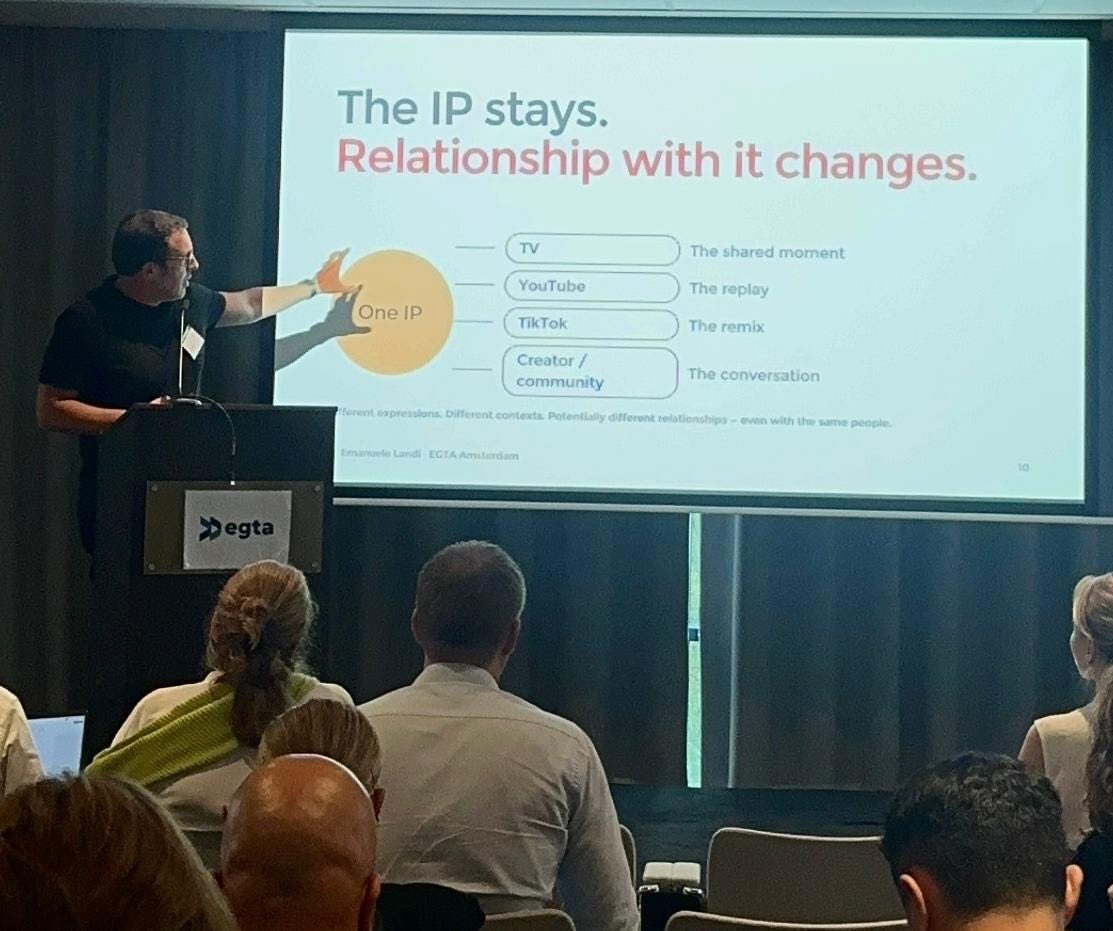
That is the broadcasters’ problem. The brand’s problem is its mirror image: if the relationship belongs to the content, what does an advertiser do standing inside it?
Part 2 · Talking back to television with Rick Howe
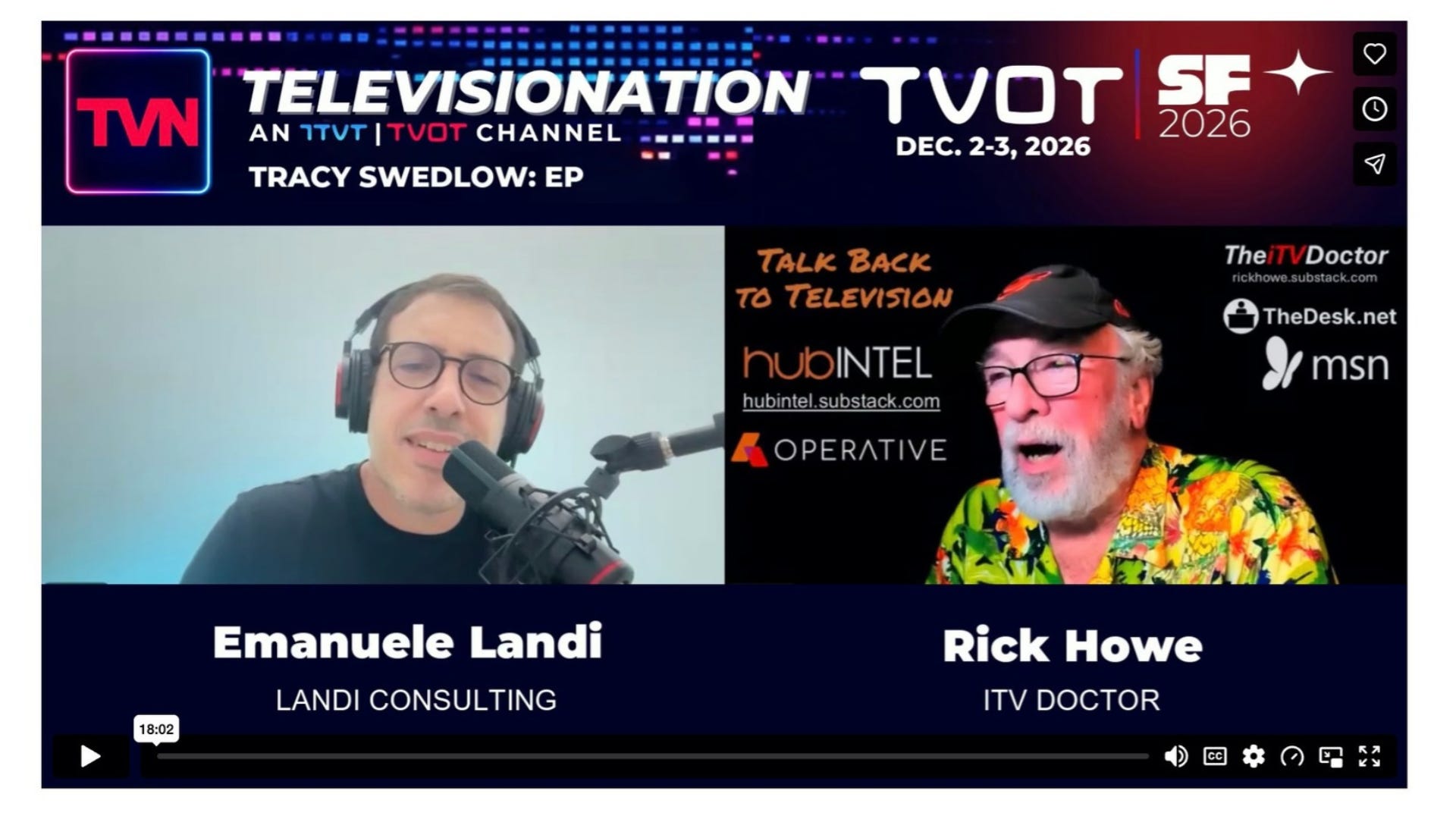
The diary. On October 7, the day before Amsterdam, ITVT published my conversation with Rick Howe in its Televisionation series (watch it here). Rick asked me about my thesis on scrolling beating binge and what happens to advertising then.
What I argued. In the conversation I take the brand’s side of the question: why scrolling wins over binge, and why brands that rent a space where a person is there for something else should contextualise themselves much better. What I mean is adaptive dynamic creatives if you entere into a specific bubble and media and become a creator with your own bubble if you want to exploit scrolling economy.
The link with Part 1 is direct. If the relationship belongs to the content, an advertiser inside a feed, a stream or a creator’s video is a guest in someone else’s relationship, and the advertiser’s job is to earn a place in it. It is the thread of the imperial advertising idea from my previous article here
https://www.contentwithaview.com/p/imperial-advertising-in-a-feudal
Part 3 · What to do on Monday
The diary. After Amsterdam and the conversation with Rick Howe, one practical question stayed with me: does your content earn the relationship it borrows? Here is how I would start answering it.
1. Split your reporting into exposure, attention and relationship. The last column will be thin at first. Fill it with proxies: people who return by choice, branded search, follows, conversation around the content.
2. Ask what the person is there for before you buy the space. A feed, a stream and a creator’s video each have their own reason for being watched.
3. Rebuild the creative for the space, not only the format. The shared moment, the replay, the remix and the conversation call for different ads.
4. Check what you keep when the deal ends. If you rent an IP, a media company or a creator, run the Afterlife test below.
5. Measure whether your content earns engagement, not just delivery. That is where the BCS comes in. Brand Communication Score is an AI agent I built that gives you a quick cross social index of the efficiency of your social content. It is important to understand if you use those channels as a nice repository of content or an engine of engagement or sales.
Three free tools
Are you a creator or a broadcaster? Nine questions to see whether the attention you build is owned or rented. Clic here to check https://www.contentwithaview.com/p/your-brand-is-a-creator-or-a-broadcaster
The Afterlife test. For any partnership with an IP, a media company or a creator: what do you keep when the deal ends? Owned assets, a real community and first-party data rather than a borrowed list, negotiated exit terms, a measured decay curve. [LINK TEST]
The Brand Communication Score (BCS). An agent I built that scores from 0 to 100 how effective a brand’s communication and content are across social platforms, on attention and engagement parameters, against sector benchmarks drawn from public data. It does not measure the relationship itself, and I would not claim it does. It tells you whether your content earns attention and engagement or only gets delivered, which is the first step in separating the two. It is in beta, and I will run a free test for anyone who wants one: send me a DM on LinkedIn with the brand or channel you want checked.
If you try one of them, tell me what you find. I read every reply.
Shout out for a new “get your influence” - meet me at Intersections in Milan 28-29 October and book your seat at my masterclass. If you do not have a pass DM me and I will be glad to give you one.