

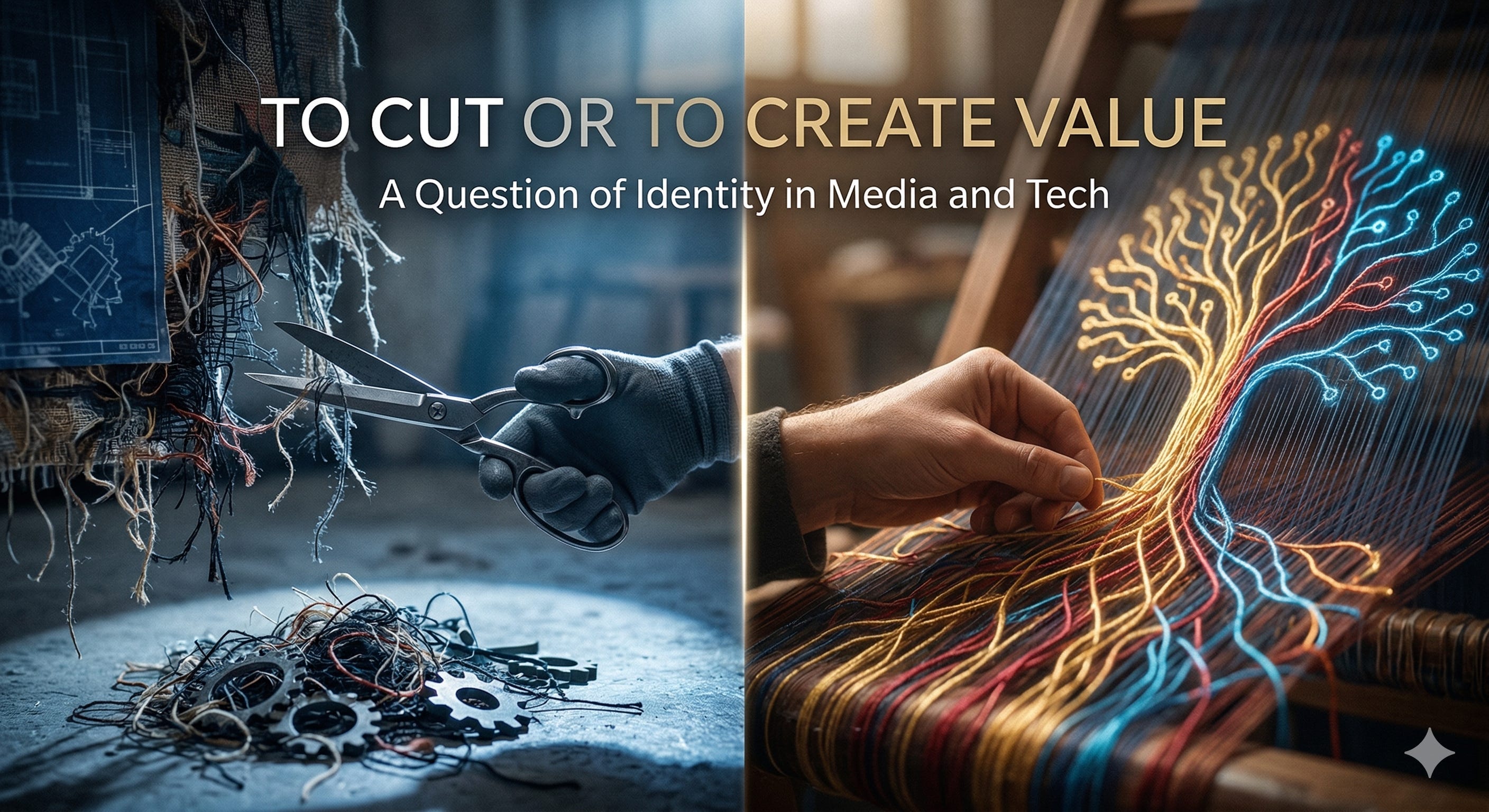
I have read and heard many explanations for the layoffs.
AI.
Markets.
Interest rates.
Geopolitics.
The end of post-pandemic euphoria.
All true. But I am not particularly interested in repeating the usual analysis of structural changes in the global market.
What interests me more is what gets discussed less: when conditions worsen, many companies suddenly realize they are not clear at all about where their value actually comes from. And when you can no longer explain what you are really protecting, you almost always end up protecting margin instead. In the simplest possible way: by cutting.
The point is not to deny external pressure. The point is to ask why, under the same pressure, some organizations rethink their structure while others default to reducing labor costs as if that were the only language available.
For anyone working in media, advertising, television, streaming, or technology consulting, that is the real issue.
In the US, the signal comes earlier. In Europe, it arrives later.
The US numbers are quite clear. According to Challenger, the media/news sector in the United States announced 17,163 job cuts in 2025, up from 15,039 in 2024. After the IPG deal, Omnicom announced more than 4,000 layoffs. Those are not impressions. They are facts.
In Europe, the picture is less violent in the headlines, but not necessarily more reassuring. In February 2026, Christine Lagarde said that the eurozone is not yet seeing a broad, generalized wave of AI-driven layoffs. That matters. It means the shock arrives here with more friction, more delay, more filters. Not that it does not arrive at all.
That makes sense. Labor rules are different. Consultation timelines are different. The relationship between business and employment is less brutal than in the US. But the logic driving many large European companies, especially in globalized sectors like media, advertising and tech, is often very similar to the American one: efficiency, centralization, simplification, cost compression, quarterly results.
That is why comparing the US and Europe still makes sense, even without forcing perfect statistical symmetry. We are not looking at two identical markets. We are looking at two different ways of absorbing the same pressure. The US gets the signal first. Europe often absorbs the wave later.
AI matters. But it is often used as a polished alibi.
AI is changing work. Denying that would be ridiculous. The World Economic Forum estimates that 39% of core skills will change by 2030. So yes, job redesign is real.
The problem is that, in many cases, AI is used as a total explanation. And that allows many companies to avoid a more uncomfortable question.
The question is: did we even have a sound structure before AI entered the picture?
Because very often AI is simply exposing problems that were already there: duplicated roles, organizations that grew by inertia, functions built through sediment rather than design, reporting replacing decision-making, poor alignment between strategy and people, and confusion around the most basic and important issue of all: who creates value, how they create it, and why.
That is why I find the simplified debate about AI “replacing” jobs rather uninteresting. What interests me more is something else: how clear are companies today about what should be automated, what should be redesigned, and what should instead be protected because it still represents a real competitive difference?
The Omnicom-IPG merger is defensive.
I have written this before, and I still believe it.
When an industry enters a season of mega-mergers, it is not always expressing strength. Often it is looking for shelter. It is buying scale. Buying time. Reassuring the market. This is a defensive move, not just an industrial vision.
That is how I read the Omnicom-IPG merger.
That does not mean it is irrational. It means it should be called by its real name. These operations are often presented as modernization, while in many cases they signal the opposite: an industry struggling to defend, in economic terms, what made it central in the first place.
And that is where things become serious.
The media industry was born as a cultural industry. Advertising was not born as an efficiency exercise. It was born out of the ability to read desire, build meaning, and make a brand memorable. Television, in whatever form, was not born as inventory. It was born as a form of collective imagination.
That is why I keep asking a question that is heard far too rarely in this industry: what is the economic value of the media industry’s output today? What are we actually selling?
Is it valuable enough not to be treated as creative cost to be compressed? Are we giving up on understanding what shapes the imagination of the audience that buys that product? Or are we still trying to do it, just at one-third of the cost?
Because if the answer is no — and yes to the last one — then we are not witnessing some brilliant sector transformation. We are witnessing its gradual cultural reduction.
Constant optimization does not automatically create structural value.
There is an almost automatic belief that optimization is always a good thing.
I am not convinced.
Optimization works when you know what you are trying to protect. If you do not, optimization becomes a very elegant form of impoverishment. You cut costs, clean up the P&L, improve a few metrics, maybe the market applauds. But that does not necessarily mean you are making the company stronger. You may simply be consuming its future.
That is what I see more and more often.
Creativity gets cut because it is harder to defend on a dashboard, or because acceptable low-cost shortcuts can be found.
Seniority gets cut because execution is preferred — but execution of what, exactly?
Everything that cannot be translated immediately into short-term performance gets cut.
At some point, someone will still have to answer a very simple question: if you progressively empty out the industry’s creative and symbolic engine, what exactly do you expect to monetize tomorrow?
And this matters even more now, when everyone talks about AI as if it were only an efficiency lever.
In Europe, AI does not reduce the human role. It makes it heavier.
To me, this is the most misunderstood point.
With the AI Act, Europe is not telling companies to remove human beings from the process. It is saying something quite different: the more AI enters business processes, the more human oversight, governance, accountability and intervention capacity are required. Providers and deployers must also ensure a sufficient level of AI literacy among the staff involved.
In other words, human value does not disappear. It changes position.
It matters less in repetitive execution. It matters more in judgment, context, boundaries, responsibility, and correction.
This seems huge to me, and yet it is still poorly understood in business debate. It is easier to sell AI as a shortcut to productivity than as a force that compels companies to seriously rethink the quality of their governance.
But that is exactly where part of the difference between mature organizations and confused ones will be decided.
The final question I keep asking is this:
when we have optimized everything, who will produce the next thing left to optimize?
_____________
Stiamo vivendo un momento di correzione di rotta senza precedenti nel mercato del lavoro e soprattutto in quello media, tech e pubblicitario. Ho letto e ascoltato molte spiegazioni sui licenziamenti.
AI.
Mercati.
Tassi.
Geopolitica.
Fine dell’euforia post-pandemia.
Tutto vero. Ma non mi interessa qui tanto pontificare sugli inevitabili cambiamenti strutturali del mercato globale.
Vorrei focalizzarmi su ciò che si racconta meno: molte aziende, quando il contesto peggiora, scoprono di non avere affatto chiaro dove nasce il loro valore. E quando non sai più spiegare bene che cosa stai difendendo, finisci quasi sempre per difendere il margine. Nel modo più semplice. Tagliando.
Il punto non è negare la pressione esterna. Il punto è capire perché, a parità di pressione, alcune organizzazioni ripensano la propria struttura e altre si limitano a ridurre il costo del lavoro come se fosse l’unico linguaggio disponibile.
Per chi lavora nei media, nella pubblicità, nella televisione, nello streaming e nella consulenza tecnologica, il tema vero è qui.
Negli Stati Uniti il segnale arriva prima. In Europa arriva dopo.
I numeri americani parlano chiaro. Secondo Challenger, nel 2025 il settore media/news negli Stati Uniti ha annunciato 17.163 tagli, in aumento rispetto ai 15.039 del 2024. Omnicom, dopo l’operazione IPG, ha annunciato oltre 4.000 esuberi. Non sono impressioni. Sono fatti. (challengergray.com)
In Europa il quadro è meno violento nei titoli, ma non per questo più rassicurante. A febbraio 2026 Christine Lagarde ha detto che nell’eurozona non si vede ancora una vera ondata generalizzata di licenziamenti trainata dall’AI. È una frase importante. Significa che qui il colpo arriva con più attrito, più lentezza, più filtri. Non che non arrivi. (reuters.com)
Del resto è normale. Le regole sul lavoro sono diverse, i tempi di consultazione sono diversi, il rapporto tra impresa e occupazione è meno brutale di quello americano. Ma le logiche che governano molte grandi aziende europee, soprattutto in settori globalizzati come media, advertising e tech, sono spesso molto simili a quelle statunitensi: efficienza, centralizzazione, semplificazione, compressione dei costi, quarter results.
Per questo il confronto tra Stati Uniti ed Europa ha senso anche senza forzare una simmetria statistica perfetta. Non stiamo osservando due mercati uguali. Stiamo osservando due modi diversi di assorbire la stessa pressione. Gli Stati Uniti anticipano il segnale. L’Europa spesso ne assorbe l’onda più tardi.
L’AI c’entra. Ma spesso viene usata come alibi elegante.
L’AI sta cambiando il lavoro. Sarebbe ridicolo negarlo. Il World Economic Forum stima che entro il 2030 il 39% delle skill chiave cambierà. Quindi il ridisegno dei ruoli è reale. (reports.weforum.org)
Il problema è che in molti casi l’AI viene usata come spiegazione totale, e questo consente a tante aziende di evitare una domanda più scomoda.
La domanda è: avevamo davvero una struttura sensata anche prima?
Perché molte volte l’AI non fa altro che illuminare problemi già presenti: ruoli duplicati, organizzazioni cresciute per inerzia, funzioni costruite per sedimentazione, reporting al posto della decisione, scarso allineamento tra strategia e persone, confusione sul fatto più semplice e più importante di tutti: chi crea valore, in che modo lo crea, e perché.
Per questo trovo poco interessante il dibattito semplificato sul fatto che l’AI “sostituirà” il lavoro. A me interessa di più un’altra cosa: quanta chiarezza hanno oggi le aziende su ciò che va automatizzato, su ciò che va ripensato e su ciò che invece andrebbe protetto perché rappresenta ancora una differenza competitiva.
La fusione Omnicom-IPG è difesa.
L’ho già scritto e continuo a pensarlo.
Quando un settore entra nella stagione delle mega-fusioni non sempre sta esprimendo forza. Spesso sta cercando riparo. Sta guadagnando massa. Sta comprando tempo. Sta rassicurando il mercato. È una mossa difensiva, non (solo) una visione industriale.
La fusione Omnicom-IPG, per me, va letta così.
Il che non significa che sia irrazionale. Significa che va chiamata col suo nome. Queste operazioni vengono spesso raccontate come modernizzazione, ma molte volte segnalano il contrario: un’industria che fa più fatica a difendere economicamente ciò che l’ha resa centrale.
E qui il punto si fa serio.
L’industria media nasce come industria culturale. La pubblicità non nasce come esercizio di efficienza. Nasce come capacità di leggere il desiderio, costruire senso, rendere memorabile una marca.
La televisione in qualunque forma sia non nasce come inventory. Nasce come forma di immaginario collettivo.
Per questo continuo a farmi una domanda che nel nostro settore si sente troppo poco: qual è il valore economico dell’industry media oggi? Quale output vendiamo realmente?
Vale abbastanza da non essere trattato come costo creativo da comprimere? Stiamo rinunciando a capire cosa stimola l’immaginario del pubblico che compra quel prodotto? O forse stiamo provando a farlo ma ad un terzo del costo?
Perché se la risposta è no (e si all’ultima), allora non stiamo assistendo a una trasformazione brillante del settore. Stiamo assistendo a una sua progressiva riduzione culturale.
L’ottimizzazione continua non crea automaticamente valore strutturale
C’è una fede quasi automatica nel fatto che ottimizzare sia sempre un bene.
Io non ne sono convinto.
Ottimizzare funziona quando sai che cosa stai cercando di proteggere. Se non lo sai, l’ottimizzazione diventa una forma molto elegante di impoverimento. Tagli costi, pulisci il conto economico, migliori qualche indicatore, magari il mercato applaude. Ma non è detto che tu stia rafforzando l’azienda. Potresti stare semplicemente consumando il futuro.
È quello che vedo sempre più spesso.
Si taglia la creatività perché è più difficile da difendere in una dashboard o si trovano formule accettabili per farla velocemente e a basso costo.
Si taglia la seniority perché si preferisce execution (ma execution di cosa?)
Si taglia tutto ciò che non ha una traduzione immediata in performance di breve.
Perché a un certo punto qualcuno dovrà pur rispondere a questo: se svuoti progressivamente il motore creativo e simbolico dell’industria, che cosa pensi di monetizzare domani?
E questo conta ancora di più nel passaggio storico in cui tutti parlano di AI come se fosse soltanto una leva di efficienza.
In Europa l’AI non riduce il ruolo umano. Lo rende più pesante.
Questo, secondo me, è il punto più frainteso.
L’Europa, con l’AI Act, non sta dicendo alle aziende di togliere gli esseri umani di mezzo. Sta dicendo qualcosa di molto diverso: più l’AI entra nei processi, più servono supervisione umana, governance, accountability, capacità di intervento. Inoltre provider e deployer devono garantire anche un livello sufficiente di AI literacy del personale coinvolto. (digital-strategy.ec.europa.eu)
Tradotto: il valore umano non sparisce. Cambia posizione.
Conta meno sul piano dell’esecuzione ripetitiva. Conta di più sul piano del discernimento, del contesto, del limite, della responsabilità, della correzione.
A me sembra un punto enorme, e nel dibattito aziendale viene colto poco. Perché è più facile raccontare l’AI come scorciatoia di produttività che come fattore che costringe a ripensare seriamente la qualità della governance.
Ma è esattamente lì che si giocherà una parte della differenza tra organizzazioni mature e organizzazioni confuse.
La domanda finale che faccio è: quando avremo ottimizzato tutto, chi produrrà la prossima cosa da ottimizzare?